
Christopher Mims, Cut Through the Hype. Master the Basics. Transform Your Work. (Crown Currency 2026). Available from Bookshop.org (supports independent booksellers), Barnes and Noble, and Amazon.
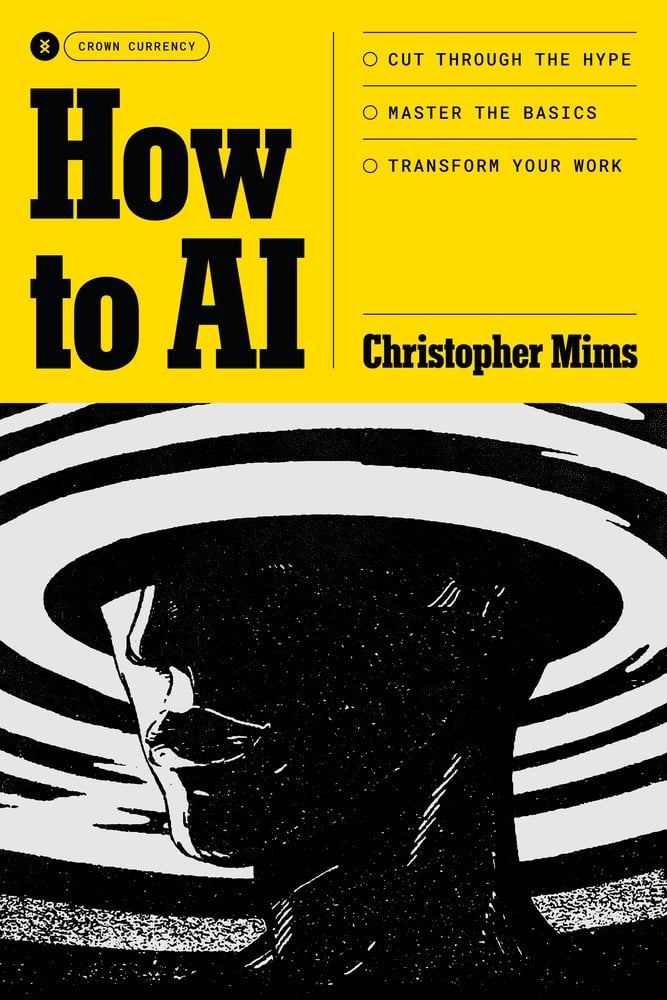
In the current publishing cycle, books about AI are being produced at a rate that suggests at least some were written with hyperspeed AI. How To AI swims against the tide of fast, disposable books. It’s a keeper.
Christopher Mims’s background and track record as a Wall Street Journal reporter covering technological advances give him the hype-resistance and, at least as important, the perspective to write about AI. You have to like any writer whose bio says he has covered “bidets, brain implants, the cult of the founder, the history of technology, innovation, venture capital, robotics, batteries, energy, materials science, wireless communications, AI, data science, telepresence, microchips, logistics, IT, 3D printing, and autonomous boats, trucks, cars, drones, and flying taxis.”
He is also an engaging writer. As many of us grow older, we have less tolerance for books that read like abstract Ph.D. theses (including AI for Lawyers, among others). Mims, blessedly, focuses on stories about real people doing real things.
Chapter 1 includes an example likely to be especially convincing for legal professionals: the profile of a Dallas personal injury lawyer, Kim Jones Pennepaker. Her approach serves as a model for lawyers seeking to incorporate AI into their practice while avoiding the embarrassment of hallucinations.
Mims is adept at adding occasional humor. I liked this line: “Herbert Simon, then a professor at Carnegie Mellon University, suggested the name complex information processing. Alas, you can see why that never caught on.”
Mims skillfully expands on a key theme from Ethan Mollick’s best-selling book, Co-Intelligence: Living and Working With AI. Artificial Intelligence works best when treated as a capable assistant, fast and sometimes surprisingly insightful, yet prone to error. The user’s role is to ask the right questions and then evaluate the responses with judgment that only humans can bring to bear.
Mims’s explanation of hallucinations, why they occur, how to make them less frequent, and how to catch the ones that slip the net, is a highlight. He understands that the problem is not that AI makes things up. It is that it does so fluently.
Words Shape Our Thoughts
The phrase “artificial intelligence” has become so ubiquitous that it doesn’t mean much to many people. Mims’s alternative, “simulated intelligence,” is more useful. As he explains:
[The phrase] simulated intelligence reminds us that while AI can sometimes fool us into thinking it’s intelligent in the same ways that we are, at a fundamental level we’re dealing with something very different from us. It emphasizes just how alien it is, compared to ourselves, our pets, even the things that creep and crawl on this earth …”
This approach is similar to Richard Susskind’s essential-for-lawyers 2025 book How to Think About AI: A Guide for the Perplexed. Susskind describes key AI capabilities as “quasi-judgment,” “quasi-empathy,” and “quasi-creativity.”
For lawyers, these shifts in vocabulary and ways of looking at things are more than academic. If AI is understood as simulated rather than actual intelligence, its outputs are not conclusions from infallible oracles but drafts. This shifts the emphasis from trust to verification.
Mims provides welcome additional definitions of key concepts in a section titled “Terms” at the end of each chapter. Truly understanding the vocabulary gets you at least half of the way home in most fields, right?
I have never read a perfect book (though when I was 18, I thought Catch-22 might qualify). The obvious trap for a book about AI is that the rapid pace of new developments makes most books age quickly. It’s kind of like writing a treatise on current K-Pop stars. Mims’s clear explanations and focus on basic principles give this book more staying power than most.
Bottom Line
How to AI succeeds because it understands its audience. It is not for engineers or researchers. It is for professionals who want to use AI effectively without becoming specialists—or spending six months deciding what they think about it first.
This book lives up to its title. It is one of the most useful and practical guides available on how professionals can use AI. It belongs on my short must-read list for lawyers alongside Mollick’s Co-Intelligence and Susskind’s How to Think About AI.