
This is an overview of selected articles that highlight the devastating impact of the Trump administration’s dismantling of agencies across the federal government, with a focus on cancelling critical scientific and health related research grants, as reported in July, 2025. The total cancellation of funds is escalating as grant suspensions are ongoing, but it is in the billions of dollars. Unilateral, sweeping and rapid actions are targeting a wide range of projects, programs, education and funding for research on critical health issues including: Alzheimers’, cancer, the climate crisis, weather and forecasting, vaccines, HIV, infectious diseases, food and drug safety, fossil fuel air and water pollution. The attack on science and medicine is not limited to the research arena. It also encompasses denial of public access to data, research and information, paid by taxpayer dollars, deleted from hundreds of government as well as academic websites. My previous article, Climate and DEI Deleted From Government Websites, Federal Workers Fired, Colleges Erase Programs, Law Firms Blackballed, Holocaust Erased, Science Research Curtailed, updated until June 2025, identifies a wide range of reports, publications, research and data removed at the direction of the Trump administration commencing in January 2025. This government mandated censorship has expanded beyond the groups I initially referenced to the broadcasting, television, news and entertainment industry. In addition, on August 1, 2025 the Corporation for Public Broadcasting “announced that it will begin an orderly wind-down of its operations following the passage of a federal rescissions package and the release of the Senate Appropriations Committee’s FY 2026 Labor, Health and Human Services, Education, and Related Agencies (Labor-H) appropriations bill, which excludes funding for CPB for the first time in more than five decades.”
This guide expand on my previous article with subject matter specific sources on the massive and fast moving effort to censor and delete research and data from the public and private sectors. These additional articles and reports shine a bright light on how the foundation of our healthcare system and our leadership in pioneering scientific research, with a global impact, has been purposefully targeted and perhaps irrevocably fractured.
The framework and mechanism for the extensive defunding of science is found in H.R.1 – One Big Beautiful Bill Act 119th Congress (2025-2026) Public Law No: 119-21 (07/04/2025). This act reduces taxes, reduces or increases spending for various federal programs, increases the statutory debt limit, and otherwise addresses agencies and programs throughout the federal government.
Along with the text of the H.R. 1, please see three sources germane to Trump’s ongoing efforts to shrink the federal government, agency by agency.
- Project 2025, Election 2024, and America’s Future, posted on beSpacific, June 24, 2024 Via TIME – “Project 2025 led by the right-wing think tank the Heritage Foundation, Project 2025 is a presidential transition operation—basically a government-in-waiting if former President Donald Trump returns to office on Jan. 20, 2025…The project, published in 2023, includes a nearly 1,000-page handbook that detailed a conservative agenda for the next president.”
- Project 2025 Tracker. Track and search Detailed Project Objectives by Agency, Subject and Status [Started, In Progress, Complete] Details are provided for each objective specific to agency, including Executive branch [White House for example has achieved to date 88% of the objectives detailed in Project 2025. Each entry also includes references to sources that support the completion of each objective, as well as the page(s) in which the objective(s) appear in the text of Project 2025. Project 2025 was presented as the operational plan to destroy our federal government, and it is being used to accomplish this goal.
- The White House’s plan to downsize the federal government, in charts [no paywall], published by the Washington Post on July 16, 2025. It provides a high level overview of the impact of firing, layoffs, forced retirements, and forced early retirements that have largely carved out the ability of the executive branch of the federal government to plan and execute the goals and objectives mandated for each agency. President Donald Trump and his advisers have called for dramatically shrinking the size and scope of the federal government, dispatching officials to agency after agency to block funding and slash staffing. The [Supreme Court has revived the administration’s efforts to lay off workers,] allowing planned reductions in force to resume in a ruling last week. The State Department announced staff cuts a few days later. The administration aims to go beyond that. As part of Trump’s 2026 budget request, the White House laid out in detail how many employees the executive branch hopes to cut. It envisions a government with 5 percent fewer employees compared to the final year of the Biden administration.
As a note, if articles and sources are behind a paywall, or otherwise archived due to censorship by the government, and many are, I have provided links to access them free, in some cases, with a few extra steps.
RFK Jr. pulls funding for vaccines being developed to fight respiratory viruses, Health WASHINGTON (AP) — The Department of Health and Human Services will cancel contracts and pull funding for some vaccines that are being developed to fight respiratory viruses like COVID-19 and the flu. Robert F. Kennedy Jr., the health secretary and a longtime vaccine critic, announced in a statement Tuesday that $500 million worth of vaccine development projects, all using mRNA technology, will be halted. The projects — 22 of them — are being led by some of the nation’s leading pharmaceutical companies like Pfizer and Moderna to prevent flu, COVID-19 and H5N1 infections.
HHS bars liaison members from ACIP work groups. University of Minnesota, CIDRP, August 1, 2025. In another change to how the Centers for Disease Control and Prevention (CDC) vaccine advisory group operates, the Department of Health and Human Services (HHS) on July 31 sent a letter to members of about 30 nonvoting liaison groups from medical and public health organizations that bars their participation on work groups, CNN reported, based on a letter it obtained. The email called the liaison members special interest groups that are expected to be biased based on the constituencies they represent. The liaison groups include organizations such as the American Academy of Pediatrics and the American College of Obstetricians and Gynecologists. The work groups have typically assisted with vaccine efficacy and safety reviews, considering the age-groups that would most benefit and weighing the costs and benefits. Work groups, which also include CDC staff, craft the wording of proposed recommendations for discussion and vote at Advisory Committee on Immunization Practices (ACIP) meetings. Liaison members don’t vote on the recommendations at the meetings but can ask questions and comment on presentations. In early June, HHS Secretary Robert F. Kennedy Jr. removed all 17 members of the previous ACIP and replaced them with eight new members, including several who are vaccine skeptics or have little expertise in vaccine science. At its first meeting of the new group in July, the group revived long-discredited antivaccine boilerplate topics, including thimerosal as a vaccine additive and the cumulative effects of childhood vaccines. ACIP’s charter notes about 30 specific groups that hold nonvoting seats on the ACIP. It also allows the HHS secretary to appoint other liaison members based on the committee’s needs. According to longstanding ACIP work group operating procedure rules, last updated in August 2018, liaison members and ex-officio members must sign an annual membership agreement and conflict-of-interest forms.
NSF Grant Suspensions at UCLA total $90M lost in value. Grant Witness, August 1, 2025. The Trump administration suspended 280 active National Science Foundation grants to the University of California – Los Angeles this week. The total grant value from these grants amount to over $179 million, with $90 million remaining unspent and lost in value. This brings the total number of terminations in our NSF database to over 2600 and $1.37 billion in total value.
The government is paying more than 154,000 federal employees not to work as part of the Trump administration’s deferred resignation program, according to two administration officials. Washington Post, July 31, 2025. The number, which has not been previously reported, accounts for workers at dozens of agencies who took offers from the government as of June to get paid through Sept. 30 — the end of the fiscal year — or the end of 2025 and then voluntarily leave government, significantly reducing the size of several major agencies, according to two Office of Personnel Management officials, who spoke on the condition of anonymity to disclose details of the administration’s plans to scale down government. The buyouts have rapidly sped up the process of slashing the federal workforce at an unprecedented rate, the officials said. But critics have argued the administration’s tactics of using buyouts and administrative leave have been wasteful because the public is paying tens of thousands of employees not to work for months.
We fact-checked the Trump administration’s climate report – [no paywall] Washington Post, July 31, 2025. The Energy Department released a report this week promising a “critical review” of climate science, coinciding with the Environmental Protection Agency’s move to end climate regulation across the federal government. Washington Post, July 31, 2025. But scientists say the report, drafted by researchers known for questioning mainstream climate science, is riddled with errors and cherry-picked data. “They cherrypick data points that suit their narratives and exclude the vast majority of the scientific literature that does not,” Zeke Hausfather, a climate scientist and the climate research lead at the payment company Stripe, whose work was cited in the new report, said in a text message. “This gives a terribly skewed view of the underlying climate science.”
Scientists argue that the new report, composed in less than two months by five authors known to have skeptical views on climate science, would not pass any peer review process. “If almost any other group of scientists had been chosen, the report would have been dramatically different,” Andrew Dessler, a climate scientist at Texas A&M University, said in a statement. “There is a history of some of the authors of this document cherry-picking dates to show that there is no change, but they’re not providing the evidence to support that,” said Kristie Ebi, a professor of global health at the Center for Health and the Global Environment at the University of Washington.
New PSI Report Reveals Billions in Taxpayer Dollars Squandered by DOGE. July 31, 2025. U.S. Senator Richard Blumenthal (D-CT), Ranking Member of the Permanent Subcommittee on Investigations (PSI) released a Minority staff report today unveiling that Elon Musk’s brainchild, the Department of Government Efficiency (DOGE), has generated at least $21.7 billion in waste across the federal government between January 20, 2025, and July 18, 2025. The report, “The $21.7 Billion Blunder: Analyzing the Waste Generated by DOGE,” follows a months-long investigation into Elon Musk and DOGE and is the most comprehensive effort to date to quantify taxpayer dollars squandered by DOGE despite its ostensible goal of eliminating government waste.
“This report is a searing indictment of DOGE’s false claims. At the very same time that the Trump Administration is cutting health care, nutrition assistance, and emergency services in the name of ‘efficiency’ and ‘savings,’ they have enabled DOGE’s reckless waste of at least $21.7 billion dollars,” said Blumenthal. “As my PSI investigation has shown, DOGE was clearly never about efficiency or saving the American taxpayer money. I urge Inspectors General to take up our investigation’s findings and initiate a comprehensive review of DOGE’s careless actions.” PSI’s comprehensive review of publicly available resources and independent analysis has found that DOGE has generated $21.7 billion in waste so far this year…”
- A copy of PSI’s Minority staff report is available here. Blumenthal’s letters to Inspectors General are available here.
- Today’s report follows an April 2025 memo completed by PSI Minority staff that estimated the legal liability Elon Musk was able to avoid through his previous efforts to gut the federal workforce and exert influence over federal agencies while he was at the helm of DOGE. PSI found that Musk and his companies were able to avoid at least $2.37 billion in potential liability due to federal investigations or other regulatory actions. A copy of PSI’s memo is available here.”
An EPA rule change threatens to gut US climate regulations, MIT Technology Review [no paywall], July 30, 2025 The endangerment finding underpins the EPA’s ability to regulate greenhouse gases. The Trump administration is trying to reverse it.
The End of America as a Center of Science – Kottke, July 31, 2025. Ross Anderson writes about how scientific empires, from the ancient Sumerians to the Nazis to the Soviet Union in the 1950s, have crumbled (or been willfully dismantled by ideologues) and the clear signs that the same thing is happening here in the United States under the conservative regime.
The very best scientists are like elite basketball players: They come to America from all over the world so that they can spend their prime years working alongside top talent. “It’s very hard to find a leading scientist who has not done at least some research in the U.S. as an undergraduate or graduate student or postdoc or faculty,” Michael Gordin, a historian of science and the dean of Princeton University’s undergraduate academics, told me. That may no longer be the case a generation from now.
Foreign researchers have recently been made to feel unwelcome in the U.S. They have been surveilled and harassed. The Trump administration has made it more difficult for research institutions to enroll them. Top universities have been placed under federal investigation. Their accreditation and tax-exempt status have been threatened. The Trump administration has proposed severe budget cuts at the agencies that fund American science — the NSF, the NIH, and NASA, among others — and laid off staffers in large numbers. Existing research grants have been canceled or suspended en masse. Committees of expert scientists that once advised the government have been disbanded. In May, the president ordered that all federally funded research meet higher standards for rigor and reproducibility — or else be subject to correction by political appointees.
And so:
Funding for American science has fluctuated in the decades since [World War II]. It spiked after Sputnik and dipped at the end of the Cold War. But until Trump took power for the second time and began his multipronged assault on America’s research institutions, broad support for science was a given under both Democratic and Republican administrations. Trump’s interference in the sciences is something new. It shares features with the science-damaging policies of Stalin and Hitler, says David Wootton, a historian of science at the University of York. But in the English-speaking world, it has no precedent, he told me: “This is an unparalleled destruction from within.”
EPA Plans to Revoke Legal Basis for Tackling Climate Change, The New York Times [no paywall], July 29, 2025: “Lee Zeldin, the Environmental Protection Agency’s administrator, said the agency would rescind a 2009 declaration, which concluded that planet-warming greenhouse gases pose a threat to public health and underpins the government’s legal authority to combat climate change. Speaking on a conservative podcast called “Ruthless,” Mr. Zeldin said the E.P.A. planned to rescind the 2009 declaration, known as the “endangerment finding,” which concluded that planet-warming greenhouse gases pose a threat to public health. The Obama and Biden administrations used that determination to set strict limits on greenhouse gas emissions from cars, power plants and other industrial sources of pollution. “Repealing it will be the largest deregulatory action in the history of America,” Mr. Zeldin said. He said the finding and the regulations that stemmed from it “cost Americans a lot of money.” …Without the endangerment finding, the E.P.A. would be left with no authority under the Clean Air Act to regulate the greenhouse gas emissions that are accumulating in the atmosphere from the burning of fossil fuels, leading to rising seas, fiercer storms, more deadly heat waves and other extreme weather events. The proposal would be President Trump’s most significant step yet to derail federal climate efforts. It marks a notable shift in the administration’s position from one that had downplayed the threat of global warming to one that essentially flatly denies the overwhelming scientific evidence of climate change. In recent weeks, the Trump administration has also moved to scrap restrictions on pollution from power plants, halt key measurements of greenhouse gases in the atmosphere and delay approvals of wind and solar energy projects on federal lands…”
- Source – EPA Releases Proposal to Rescind Obama-Era Endangerment Finding, Regulations that Paved the Way for Electric Vehicle Mandates
- See also The U.S. Department of Energy (DOE) today released a new report, A Critical Review of Impacts of Greenhouse Gas Emissions on the U.S. Climate, evaluating existing peer-reviewed literature and government data on climate impacts of Greenhouse Gas (GHG) Emissions and providing a critical assessment of the conventional narrative on climate change. The report was developed by the 2025 Climate Working Group, a group of five independent scientists assembled by Energy Secretary Chris Wright with diverse expertise in physical science, economics, climate science and academic research. Among the key findings, the report concludes that CO2-induced warming appears to be less damaging economically than commonly believed, and that aggressive mitigation strategies may be misdirected. Additionally, the report finds that U.S. policy actions are expected to have undetectably small direct impacts on the global climate and any effects will emerge only with long delays….
NIH: The quiet engine of science is being dismantled. And what you can do. Your Local Epidemiologist, July 23, 2025. In just six months, more than 5,500 research projects have been halted. That’s 5,500 unanswered questions. Thousands of communities left behind. Researchers stuck in limbo. And a generation of training lost. All of this is happening quietly, strategically, and politically. But we in science and public institutions must also own our part: We haven’t done enough to make this work visible to the people it impacts. This invisibility has consequences. Because when people don’t see science working for them, it becomes easy to tear it down…The National Institutes of Health (NIH) is the world’s largest public funder of research. It’s not one agency but a collection of 27 institutes and centers, each focused on specific areas like cancer (NCI), infectious diseases (NIAID), aging (NIA), and mental health (NIMH). NIH isn’t the only research engine in the United States (for example, there’s also the National Science Foundation that funds NASA), but NIH is by far the biggest.
Science and Democracy Under Siege – Documenting Six Months of the Trump Administration’s Destructive Actions. Union of Concerned Scientists, July 21, 2025. The first six months of President Trump’s second term have been characterized by destruction of democratic processes, divisive and vindictive actions, and chaos in federal government agencies. Since the Inauguration, the administration has systematically destroyed federal scientific systems. The Trump administration’s actions are not normal. This is an illegal power grab—a wholesale attack on the democratic systems upon which this nation was built. Between January 20 and June 30 of this year, we documented 402 attacks on science. We define “attacks on science” as actions, statements, or decisions that originate from an elected official or political appointee in a federal agency that results in the censoring, manipulation, forging, or misinforming on scientific data, results, or conclusions conducted within the government or with federal funds. When science is sidelined, people are harmed. In this report, we document the ways this administration has targeted the public science that we all depend on, and offer recommendations and resources to counter these attacks and hold the administration accountable
EPA Employees Still in the Dark as Agency Dismantles Scientific Research Office. Wired, July 21, 2025. As the EPA moves to shut down the Office of Research and Development, leadership is unable to answer questions as basic as when it will close and how many will lose their jobs.
Dismantling of EPA’s Scientific Research Arm Fulfills Key Chemical Industry Goal. Inside Climate News, July 21, 2025. Companies feared rules and lawsuits based on the Office of Research and Development’s assessments of the dangers of formaldehyde, ethylene oxide and other substances. Soon after President Donald Trump took office in January, a wide array of petrochemical, mining and farm industry coalitions ramped up what has been a long campaign to limit use of the Environmental Protection Agency’s assessments of the health risks of chemicals. That effort scored a significant victory Friday when EPA Administrator Lee Zeldin announced his decision to dismantle the agency’s Office of Research and Development (ORD). The industry lobbyists didn’t ask for hundreds of ORD staff members to be laid off or reassigned. But the elimination of the agency’s scientific research arm goes a long way toward achieving the goal they sought. In a January 27 letter to Zeldin organized by the American Chemistry Council, more than 80 industry groups—including leading oil, refining and mining associations—asked him to end regulators’ reliance on ORD assessments of the risks that chemicals pose for human health. The future of that research, conducted under EPA’s Integrated Risk Information System program, or IRIS, is now uncertain.
How your research can survive a US federal grant termination. Researchers in the United States are filing appeals, seeking court remedies, turning to philanthropy and starting GoFundMe campaigns. Nature. July 20, 2025. According to Grant Watch, a database tracking terminated grants from the NIH and the US National Science Foundation (NSF) — the country’s independent federal science-funding agency — more than 4,500 NIH grants awarded to US institutions have been terminated, representing some $6.1 billion of lost funding. And according to its 27 May account, a total of 1,752 grants, amounting to roughly $1.5 billion, had by then been terminated at the NSF.
E.P.A. Says It Will Eliminate Its Scientific Research Arm – no paywall. The New York Times, July 18, 2025. The decision comes after a Supreme Court ruling allowing the Trump administration to slash the federal work force and dismantle agencies. The Environmental Protection Agency said on Friday that it would eliminate its scientific research arm and begin firing hundreds of chemists, biologists, toxicologists and other scientists, after denying for months that it intended to do so. The move underscores how the Trump administration is forging ahead with efforts to slash the federal work force and dismantle federal agencies after the Supreme Court allowed these plans to proceed while legal challenges unfold. Government scientists have been particular targets of the administration’s large-scale layoffs. The decision to dismantle the E.P.A.’s Office of Research and Development had been widely expected since March, when a leaked document that called for eliminating the office was first reported by The New York Times. But until Friday, the Trump administration maintained that no final decisions had been made. The E.P.A.’s science office provides the independent research that underpins nearly all of the agency’s policies and regulations. It has analyzed the risks of hazardous chemicals, the impact of wildfire smoke on public health and the contamination of drinking water by hydraulic fracturing, or fracking. Its research has often justified stricter environmental rules, prompting pushback from chemical manufacturers and other industries. Lee Zeldin, the E.P.A. administrator, has boasted about cutting dozens of environmental regulations, saying he wants to make it cheaper and easier for industries to operate.
NOAA was developing a tool to help communities prepare for future rainfall. Trump officials stopped it. Washington Post, July 16, 2025. The tool would have projected how climate change could affect rainfall frequency and intensity in communities across the nation. Washington Post, July 18, 2025. The Commerce Department has indefinitely suspended work on a tool to help communities predict how rising global temperatures will alter the frequency of extreme rainfall, according to three current and former federal officials familiar with the decision, a move that experts said will make the country more vulnerable to storms supercharged by climate change. The tool is part of the National Oceanic and Atmospheric Administration’s Atlas 15 project — a massive dataset that will show how often storms of a given duration and intensity could be expected to occur at locations across the United States. The project was intended to be published in two volumes: one that would assess communities’ current risks and a second that would project how those risks will change under future climate scenarios.
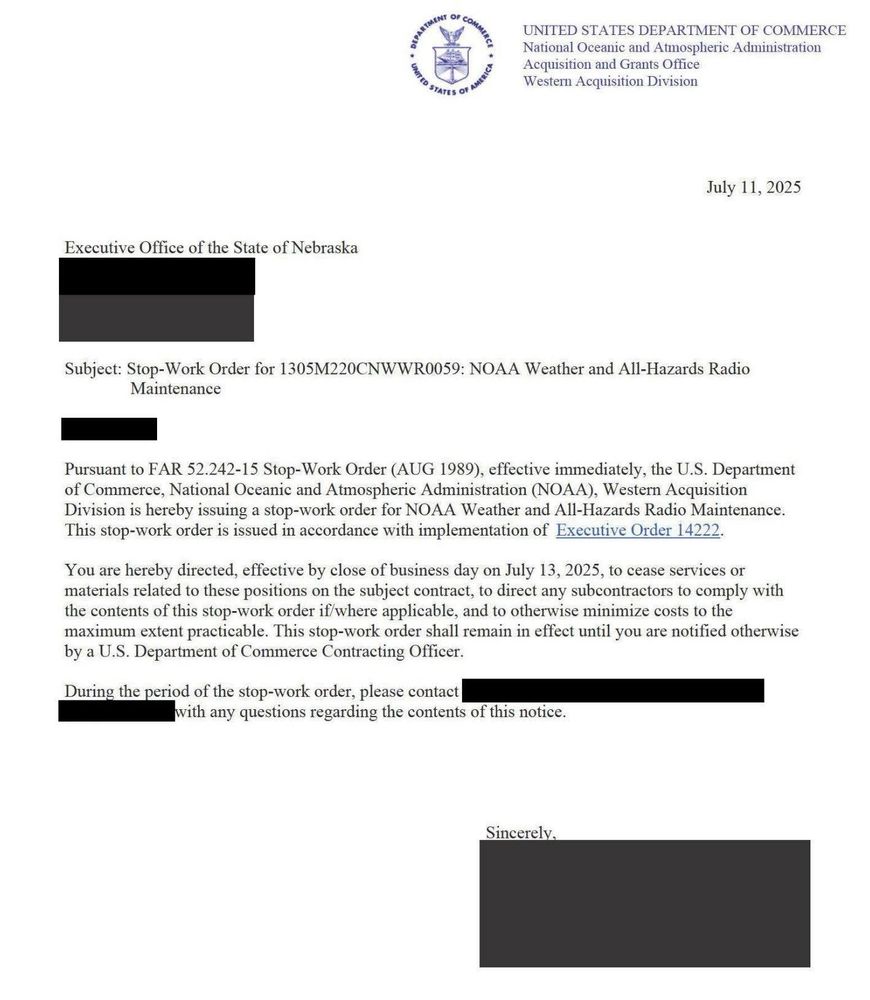
NOAA Weather Radio saves lives and it is now being ordered to shut down in some places. This letter is dated one week AFTER the deadly Kerr County flood that has taken hundreds of lives.
EPA eliminates its scientific research arm [no paywall]. Washington Post, July 16, 2025. The Office of Research and Development conducted research into hazardous chemicals, with studies that often underpinned stricter regulations. The Environmental Protection Agency said on Friday it was dismantling its scientific research branch, expanding the Trump administration’s efforts to shrink the agency. The move to eliminate the Office of Research and Development, which will prompt the exodus of hundreds of chemists and scientists assigned to conduct independent research on a range of environmental hazards, is part of a push to cut 23 percent of the agency’s staff. Its work, which often underpinned stricter federal regulations, was criticized by chemical manufacturers and other industries.
U.S. socked with 15 billion-dollar weather disasters during the 1st half of 2025,Yale Climate Connections, July 16, 2025. The Gallagher Re quarterly reports help fill a void left by the elimination of NOAA’s program to track Billion-Dollar Weather and Climate Disasters, terminated this year.
As Trump Scrubs Climate Reports, NASA Breaks Its Promise to Save Them. Gizmodo, July 16, 2025. Since taking office in January, the Trump administration has launched a major effort to limit public access to information about climate change. After the president canned the official government site that hosted the national climate assessments earlier this month, NASA has broken its promise to publish them on its own site. On Monday, July 14, NASA Press Secretary Bethany Stevens told the Associated Press that NASA will not host any data from globalchange.gov, which served as the official website for the U.S. Global Change Research Program (USGCRP). This interagency program publishes national climate assessments about every four years as mandated by the Global Change Research Act of 1990. These reports provide authoritative scientific information about climate change risks, impacts, and responses in the U.S. After the USGCRP website went dark in early July, the White House and NASA said the space agency would publish the reports on its site to comply with the 1990 law, according to the AP. Apparently, that is no longer the case. “NASA has no legal obligations to host globalchange.gov’s data,” NASA Press Secretary Bethany Stevens said in an email. Fortunately, copies of past reports are still available in NOAA’s library, and the latest report and its interactive atlas can be found here. The Trump administration essentially dismantled the USGCRP in April when it removed federal employees from their positions. It also terminated the program’s contract with ICF International, a technology and policy consulting firm that provided technical, analytic, and programmatic support for the USGCRP and particularly its national climate assessments. Later that month, the administration dismissed all scientists working on the next assessment, which was supposed to be published in 2028. Now, past reports are more inaccessible to the public than ever before.
NIH to dismiss dozens of grant reviewers to align with Trump priorities (Nature; also available at archive.ph) July 14, 2025. The move would undo years of work, leaving advisory councils understaffed, and without the full expertise needed for reviews. In an unprecedented move, the US National Institutes of Health (NIH) will soon disinvite dozens of scientists who were about to take positions on advisory councils that make final decisions on grant applications for the agency, Nature has learnt. NIH staff members have been instructed to nominate replacements that are aligned with the priorities of the administration of US President Donald Trump — and have been warned that political appointees might still override their suggestions and hand-pick alternative reviewers.
Why the federal government is making climate data disappear. Grist, July 14, 2025. Under Trump, climate denial has given way to something even more dangerous: climate erasure. For 25 years, a group of the country’s top experts has been fastidiously tracking the ways that climate change threatens every part of the United States. Their findings informed the National Climate Assessments, a series of congressionally mandated reports released every four years that translated the science into accessible warnings for policymakers and the public. But that work came to a halt this spring when the Trump administration abruptly dismissed all 400 experts working on the next edition. Then, on June 30, all of the past reports vanished too, along with the federal website they lived on. A lot of information about the changing climate has disappeared under President Donald Trump’s second term, but the erasure of the National Climate Assessments is “by far the biggest loss we’ve seen,” said Gretchen Gehrke, who monitors federal websites with the Environmental Data and Governance Initiative. The National Climate Assessments were one of the most approachable resources that broke down how climate change will affect the places people care about, she said. The reports were also used by a wide swath of stakeholders — policymakers, farmers, businesses — to guide their decisions about the future. While the reports have been archived elsewhere, they’re no longer as easy to access. And it’s unclear what, if anything, will happen to the report that was planned for 2027 or 2028, which already existed in draft form.bSo why did the reports survive Trump’s first term, but not his second? You could view their disappearance in a few different ways, experts said — as a flex of executive power, an escalation in the culture war over climate change, or a strategic attempt to erase the scientific foundation for climate policy. “If you suppress information and data, then you don’t have the evidence you need to be able to create regulations, strengthen regulations, and even to combat the repeal of regulations,” Gehrke said.
Over 2,000 senior staff set to leave NASA under agency push. The losses could endanger the administration’s plans for landing astronauts on the moon and Mars. POLITICO, July 9, 2025. At least 2,145 senior-ranking NASA employees are set to leave under a push to shed staff, according to documents obtained by POLITICO — potentially spelling trouble for White House space policy and depriving the agency of decades of experience. The 2,145 employees are those in GS-13 to GS-15 positions — senior-level government ranks that are typically reserved for those with specialized skills or management responsibilities. The losses are particularly concentrated at higher levels, with 875 GS-15 employees set to leave, according to the documents.
Inside the Collapse of the F.D.A. The New York Times [no paywall], July 8, 2025. How the new health secretary, Robert F. Kennedy Jr., is dismantling the agency. On March 27, a few days before the F.D.A.’s 27th commissioner, Martin Makary, was sworn in, Kennedy announced he would fire about 10,000 civil servants from the Department of Health and Human Services. The Food and Drug Administration would face heavy losses: 3,500 terminations in all, or 20 percent of its work force. Those layoffs were temporarily blocked by a federal judge on July 1, who said the mass firings exceeded the health secretary’s authority and were most likely illegal. But the damage was done. The offices for medical devices, tobacco products and generic drugs were all but eviscerated. The agency’s library was shuttered and subscriptions to key scientific journals canceled. Administrative staff across the agency was cut to the bone. “Dr. Makary was brought in to clean up an F.D.A. plagued by bloated bureaucracy, unaccountable leadership and regulatory capture,” says Andrew Nixon, director of communications at H.H.S. “Under his watch, the agency is finally returning to evidence-based science, speed and public service.”
Jacob Carter – SciLight July 15, 2025. Civil society has an urgent opportunity to rebuild the science advisory infrastructure. When Expert Advisors Are Sent Packing, Who Picks Up the Slack? Civil society has an urgent opportunity to rebuild the science advisory infrastructure. July 15, 2025. On July 14, Nature reported that the National Institutes of Health is planning to dismiss dozens of external scientists serving on grant-review panels. The administration will likely cite a need for “new voices,” but to many observers, this move looks less like a fresh start and more like a deliberate unraveling of scientific oversight. Advisory panels, once seen as an indispensable part of science-informed governance, are being thinned out, delayed, or dismantled. It’s a story that’s becoming all too familiar. Earlier this year, I wrote about the elimination of members of the Advisory Committee on Immunization Practices (ACIP), a panel that for decades helped guide vaccine safety and distribution policy. That news sent shockwaves through the scientific and public health communities. The experts who were terminated were replaced with members who have limited vaccine expertise or a history of being anti-vaxxers, leaving a clear impression that independent scientific judgment was no longer welcome in some corners of federal decision-making. I also wrote about the dissolution of a committee on which I was serving – the United States Geological Survey (USGS) committee on Science Quality and Integrity. And there have been dozens of other stories regarding advisory committees that have dissolved. These are not isolated incidents. From public health to environmental protection, we’re witnessing a systematic weakening of science advisory structures across the federal government. The consequences are tangible. When science is pushed aside, policymaking becomes more reactive, more politicized, and far less equipped to handle emerging crises. We’re witnessing this in real time right now with the devastating flooding news from Texas. But here’s the thing: science doesn’t disappear just because a government committee is disbanded. Expertise remains. The question is where it goes, how it continues to function, and who steps in to organize and use it. When the EPA dissolved its particulate matter advisory panel in 2018, a remarkable thing happened. The former members reconvened independently, without government funding or official authority. They produced the same kind of rigorous, transparent recommendations they had before. Their work was widely respected and ultimately helped steer public debate. It proved that scientific advisors don’t need a federal stamp to make meaningful contributions. But it also underscored something else: without formal structures, such efforts are fragile, unsustainable, and dependent on personal initiative. Which brings us to the present. Across the scientific community, frustration is growing. We know what needs to be done: government decisions must be guided by the best available evidence. However, the institutional scaffolding that enables science-informed policymaking is eroding. The public expects that policies affecting health, safety, and the environment will be guided by the weight of scientific evidence. Advisory committees are central to providing that independent, expert input. But as these bodies are dismantled and internal scientific capacity erodes, it becomes far more challenging to ensure that government decisions are grounded in rigorous evidence, potentially putting public well-being at risk This is where civil society must step up. Nonprofits, universities, and philanthropic foundations all have a role to play in rebuilding the nation’s science advisory infrastructure. Their role in helping to reform this infrastructure is not to duplicate government efforts, but to complement them. They shore up what the agency is no longer able to do. They bolster trust, instill confidence, and create independent, credible, transparent mechanisms to keep science at the table. Some models already exist for maintaining independent science advice outside formal government structures, including university-led expert panels, blue-ribbon commissions, and policy fellowships embedded in government (at least some of which are still active). Additionally, the Union of Concerned Scientists has released a toolkit designed to help scientists convene credible, independent science advisory committees when federal panels have been dismantled. The toolkit provides a practical guide for forming, structuring, and sustaining advisory groups, particularly in the absence of government support. But these efforts are scattered and often under-resourced. What we need now is investment in long-term advisory capacity that is nonpartisan, inclusive, and resilient to political headwinds.
Trump administration says it won’t publish major climate change reports on NASA website as promised AP, July 14, 2025.The Trump administration on Monday took another step to make it harder to find major, legally mandated scientific assessments of how climate change is endangering the nation and its people. Earlier this month, the official government websites that hosted the authoritative, peer-reviewed national climate assessments went dark. Such sites tell state and local governments and the public what to expect in their backyards from a warming world and how best to adapt to it. At the time, the White House said NASA would house the reports to comply with a 1990 law that requires the reports, which the space agency said it planned to do. But on Monday, NASA announced that it aborted those plans.
From Science to Diversity, Trump Hits the Reverse Button on Decades of Change. The New York Times, July 12, 2025. President Trump has moved aggressively to reopen long-settled issues and to dismantle long-established institutions as he tries to return to what he considers better times. Fluoride was introduced into drinking water starting in 1945. The flu vaccine was first made available to the general public a year later. Fuel efficiency standards for cars were adopted in 1975. Such innovations long ago became stitched into the fabric of American life, largely accepted by most Americans who came to rely on them or gave them little thought. That is, until President Trump and his team came along and began methodically rolling back widespread practices and dismantling long-established institutions. It should come as no surprise that Mr. Trump would try to undo much of what President Joseph R. Biden Jr. did over the past four years. What is so striking in Mr. Trump’s second term is how much he is trying to undo changes that happened years and even decades before that. At times, it seems as if he is trying to repeal much of the 20th century. On matters big and small, Mr. Trump has hit the rewind button. At the broadest level, he has endeavored to reverse the globalization and internationalism that have defined U.S. leadership around the globe since World War II, under presidents of both parties. But even at a more prosaic level, it has become evident that Mr. Trump, 79, the oldest president ever inaugurated, simply prefers things the way he remembers them from his youth, or even before that. He has made clear that he wants to return to an era when “Cats” was the big hit on Broadway, not “Hamilton”; when military facilities were named after Confederate generals, not gay rights leaders; when coal was king and there were no windmills; when straws were plastic, not paper; when toilets flushed more powerfully; when there weren’t so many immigrants; when police officers weren’t discouraged from being rough on suspects; when diversity was not a goal in hiring or college admissions or much of anything else.
Trump Hires Scientists Who Doubt the Consensus on Climate Change. [no paywall] The New York Times, July 8, 2025. The three scientists joined the administration after it dismissed hundreds of experts who were assessing how global warming is affecting the country. The Energy Department has hired at least three scientists who are well-known for their rejection of the overwhelming scientific consensus on climate change, according to records reviewed by The New York Times. The scientists are listed in the Energy Department’s internal email system as current employees of the agency, the records show. They are Steven E. Koonin, a physicist and author of a best-selling book that calls climate science “unsettled”; John Christy, an atmospheric scientist who doubts the extent to which human activity has caused global warming; and Roy Spencer, a meteorologist who believes that clouds have had a greater influence on warming than humans have. Their hiring comes after the Trump administration dismissed hundreds of scientists and experts who had been compiling the federal government’s flagship report on how climate change is affecting the country. The administration has also systematically removed mentions of climate change from government websites while slashing federal funding for research on global warming. In addition, Trump officials have been recruiting scientists to help them repeal the 2009 “endangerment finding,” which determined that greenhouse gases pose a threat to public health and welfare, and which now underpins much of the government’s legal authority to slow global warming, according to two people briefed on the matter who spoke on the condition of anonymity because they were not authorized to comment publicly.
Trump’s NASA budget could cede solar system to China, scientists warn. Washington Post. July 8, 2025. As the administration slashes spending on science, NASA is running low on new missions. Trump’s budget would cut NASA’s $7.33 billion science budget nearly in half. The administration’s argument is simple: NASA has too many science missions. “While NASA’s science missions have greatly expanded humanity’s understanding of the Earth, solar system, and universe, the current expenditure of over $7 billion per year on over 100 missions is unsustainable,” the president’s budget request said, adding that the administration’s $3.9 billion request will support “a leaner, more focused Science program that reflects the Administration’s commitment to fiscal responsibility.” Already the agency is seeing a brain drain. NASA officials have said they need to downsize the agency now even in advance of congressional decisions on the 2026 budget.
This government document is included as it dovetails precisely with the above references to government censorship of the sciences and its attack on all DEI related programs and activities….
New Executive Order on “Gold Standard Science”: FOIA Implications.On May 23, 2025, President Trump issued a new Executive Order No. 14303, “Restoring Gold Standard Science
.” This Executive Order is “committed to restoring a gold standard for science to ensure that federally funded research is transparent, rigorous, and impactful, and that Federal decisions are informed by the most credible, reliable, and impartial scientific evidence available.”[1] The Executive Order includes a provision that requires agencies to proactively make publicly available certain scientific information. Specifically, Section 4 states that “agency heads and employees shall adhere to the following rules governing the use, interpretation, and communication of scientific data, unless otherwise provided by law:
(b) Except as prohibited by law, and consistent with relevant policies that protect national security or sensitive personal or confidential business information, agency heads shall in a timely manner and, to the extent practicable and within the agency’s authority:
(i) subject to paragraph (ii), make publicly available the following information within the agency’s possession:
(A) the data, analyses, and conclusions associated with scientific and technological information produced or used by the agency that the agency reasonably assesses will have a clear and substantial effect on important public policies or important private sector decisions (influential scientific information), including data cited in peer-reviewed literature; and
(B) the models and analyses (including, as applicable, the source code for such models) the agency used to generate such influential scientific information. Employees may not invoke exemption 5 to the Freedom of Information Act [FOIA] (5 U.S.C. 552(b)(5)) to prevent disclosure of such models unless authorized in writing to do so by the agency head following prior notice to the OSTP Director.
(ii) risk models used to guide agency enforcement actions or select enforcement targets are not information that must be disclosed under this subsection.”[2]
Additionally, the Executive Order defines “scientific information” in the following manner:
- “Scientific information” means factual inputs, data, models, analyses, technical information, or scientific assessments related to such disciplines as the behavioral and social sciences, public health and medical sciences, life and earth sciences, engineering, physical sciences, or probability and statistics. This includes any communication or representation of knowledge such as facts or data, in any medium or form, including textual, numerical, graphic, cartographic, narrative, or audiovisual forms.[3]
The Section 4 disclosure requirement includes several disclosure limitations. Section 4 does not require the disclosure of information that the FOIA or another law requires to be withheld. Certain FOIA exemptions are non-discretionary and would therefore satisfy the “[e]xcept as prohibited by law” limitation of Section 4. Specifically, FOIA Exemption 1, which protects classified information,[4] and FOIA Exemption 3, which exempts information protected by a statute other than the FOIA,[5] must still be applied to information subject to the Executive Order. Additionally, the “sensitive personal or confidential business information” provision of the Executive Order would continue to protect information covered by FOIA Exemptions 4, 6, and 7(C). These exemptions protect, respectively, confidential commercial information obtained by outside parties, and information for which the disclosure constitutes an unwarranted invasion of personal privacy.[6] Furthermore, the disclosure requirement is limited to “influential scientific information” that “the agency reasonably assesses will have a clear and substantial effect on important public policies or important private sector decisions.”[7] Finally, agencies are not required to publish risk models for agency enforcement actions.[8]
In short, these are the Executive Order’s disclosure-related takeaways:
- The Executive Order requires proactive public disclosure of “influential scientific information” as well as models and analyses used to generate that information.
- Such information cannot be withheld from disclosure pursuant to FOIA Exemption 5 absent notice to OSTP and approval from the agency head.
- However, non-discretionary FOIA exemptions including Exemptions 1, 3, 4, 6, and 7(C) should still be applied to such information where appropriate.
- Risk models for agency enforcement actions are not subject to the disclosure requirements of the Executive Order.
The Executive Order further required that the Office of Science and Technology Policy (OSTP) issue guidance on implementing the Order.[9] On June 23, 2025, OSTP issued that guidance entitled, “Agency Guidance for Implementing Gold Standard Science in the Conduct & Management of Scientific Activities
”This memorandum requires each agency to report their intended actions to implement the Executive Order and OSTP guidance by August 22, 2025.[10] Section 3 provides additional details on what information to include in the agency report.
FOIA personnel should be made aware of the new public disclosure requirements in the Executive Order and should consult with their General Counsel’s Office for any questions regarding implementation of these requirements. Questions regarding the applicability of the FOIA to information subject to the Executive Order may also be directed to OIP.
FDA Layoffs Could Compromise Safety of Medications Made at Foreign Factories, Inspectors Say. Pro Publica, July 7, 2025. Beyond staff cuts, the departures of some longtime investigators in recent months have left less experienced people tasked with rooting out dangerous manufacturing practices. Inspectors charged with safeguarding America’s drug supply say they are reeling from deep cuts at the Food and Drug Administration despite promises by the Trump administration to preserve the work of the agency’s investigative force. Dozens of people who help coordinate travel for complex inspections of foreign drug-making factories have been let go, and though some have since been rehired, inspectors said the ongoing strain of policing an industry spread across more than 90 countries has exhausted staff and could compromise the safety of medications used by millions of people. For years, inspectors have uncovered dirty equipment, contaminated supplies and fraudulent testing records in some overseas factories — serious safety and quality breaches that can sicken or kill consumers. Last month, ProPublica reported that a generic immunosuppression drug for transplant patients could dissolve too quickly when ingested, increasing the risk of kidney failure. The drug was made at an Indian factory with a history of quality violations that was banned from the U.S. market. The company previously told ProPublica it believes the medication is safe. In April, more than 3,500 FDA employees were laid off under U.S. Department and Health and Human Services Secretary Robert F. Kennedy Jr., a roughly 15% reduction in force. “We aren’t just reducing bureaucratic sprawl. We are realigning the organization with its core mission and our new priorities in reversing the chronic disease epidemic,” Kennedy said.
The Vaccine Integrity Project is here to help, STAT, July 3, 2025. “Recently, the Department of Health and Human Services floated new standards for vaccine approvals, rescinded longstanding Covid-19 vaccine recommendations for healthy children and pregnant women, and fired all 17 members of the Centers for Disease Control and Prevention’s vaccine advisory committee. These actions represent a significant shift in the federal government’s approach to vaccine policy and the safeguarding of the public’s health. The Vaccine Integrity Project, launched in April by the University of Minnesota’s Center for Infectious Disease Research and Policy, anticipated this trajectory and the risks posed to the widely shared goal of protecting people from vaccine-preventable diseases. Its mission is simple and urgent: to ensure that vaccine use in the United States remains grounded in the best available evidence and focused squarely on protecting the public. Over the past several months, the project has engaged more than 80 stakeholders, including clinicians, academics, public health officials, insurers, and industry leaders, to assess how nongovernmental actors can defend vaccine science and use at a time when official public health channels are under stress. What emerged was a shared recognition of two immediate priorities: continuing the development and dissemination of trusted evidence-based immunization guidance and countering the spread of inaccurate health information. The Vaccine Integrity Project will soon publish its findings from these stakeholder engagements in a final report, concluding the work of its steering committee and signaling an end to its exploratory phase, shifting its focus to action. To that end, later this summer, the Vaccine Integrity Project is convening experts from across the vaccination ecosystem to assess the evidence on influenza, RSV, and Covid-19. Our partners will use this evidence base to develop immunization guidelines…”
Administration to phase out NIH support of HIV clinical guidelines. [no paywall] Washington Post, June 21, 2025. Doctors and advocates worry the move is a first step toward ending federal guidance for HIV treatment. The National Institutes of Health’s support for federal guidelines that steer the treatment of more than a million HIV patients in the United States will be phased out by next June, according to the agency’s Office of AIDS Research, a move that troubled some doctors and raised questions about whether the guidelines themselves will change. It is unclear whether Health and Human Services Secretary Robert F. Kennedy Jr. plans to bring the guidance in line with his own controversial views about an infectious disease that 30 years ago was the leading cause of death for people 25 to 44 years old. The Office of AIDS Research, which is part of the National Institutes of Health, informed members of the panels responsible for the guidelines in a letter that, “in the climate of budget decreases and revised priorities, OAR is beginning to explore options to transfer management of the guidelines to another agency within” the Department of Health and Human Services. The guidelines, detailed recommendations on how to diagnose and treat medical conditions, can affect what tests, treatments and medications are covered by insurance companies and Medicare, said Aniruddha Hazra, associate professor of medicine at University of Chicago Medicine.