
This is a follow up to two previous articles on the Trump administration’s relentless attacks against science, medicine and public health, government sponsored data collection and reporting, climate science, and the censorship of government documents, and federally funded academic research and scholarship. In July 2025 I published The Trump Administration’s Continued War Against Science, Research and Public Health and in August 2025, The Trump Administration’s Continued War Against Science, Research and Public Health – Part 2. The second article focused on sweeping administration directives, executive orders, purges of federal government agency personnel and government sponsored data, significantly impacting the effective administration of our three branches of government.
The rapid fire assault against the heart of our democracy stunningly continues to escalate following the Project 2025 roadmap operationalized under the direction of Russell Vought and Stephen Miller, fracturing our public policy, governance, the economy, muzzling the education system, and eradicating our foreign policy and diplomatic corps. These actions are compounded by new budget cuts executed using i
a surge in new personal attacks, indictments and legal threats against universities, including: UCLA and Harvard, media corporations, television personalities [Jimmy Kimmel and Stephen Colbert], individuals who are or were state or federal government officials [James Comey, Letitia James, Lisa Cook, John Bolton Christopher Wray], and specific government agencies [FEMA, IRS, Social Security, Medicare, USDA, USAID, EPA], data, statistics and reports. As the Journalist’s Resource states – “Federal datasets are one of the pillars of democracy. They underpin everything from health research and economic forecasting to climate science, disaster response, and watchdog journalism. Yet today, these essential resources face unprecedented threats: data removals, political interference, staff and contract cuts, and the quiet erosion of statistical capacity.” These flagrantly politicized actions curtail freedom of information and eliminate transparency and accountability for a range of government work in areas including the environment, food security, healthcare, energy and education.
The third article in this series opens the aperture further to bring more light to how the Trump administration has ratched up attacks on government employees, agencies, programs and services, and steeply diminished the range and impact of critical services historically provided to the American public and our engagement in humanitarian work around the world. The intersection of these factors illuminates a complex landscape where democracy is under threat from multiple sources. To summarize, this article focuses on significant targets of the Trump Administration’s attacks in the month of September 2025.
- Actions Against Medicine and Science
- Cancelling Billions in funding for research and development in medicine and science.
- Budget Cuts
- Suppression of Scientific Data
- Climate Change and Global Climate Crisis Policies
- Denial of Climate Science
- Renewable Energy Criticism
- Public Health
- Environmental Safety and Sustainability
- Supreme Court Shadow Docket and the domination of executive power
- Cancelling the publication of key annual reports on issues including hunger in America and Global Trends [a public document that predicts what challenges the United States — and the world — will face in the coming decades] and censorship of government documents.
White House Ramps Up Effort to Remove and Alter Information on Climate Change. Orgs Working to Rescue Climate Data Before It Disappears – Washington, D.C., September 30, 2025 – National Security Archive. Eight months into President Donald Trump’s second term, the administration has fundamentally distorted the federal information landscape as it continues to rewrite and erase resources about climate change, environmental justice, and climate diplomacy. In a follow up to a previous posting on the administration’s first two weeks of environmental data overhaul, the National Security Archive’s Climate Change Transparency Project today publishes an update of the most recent actions the administration has taken to “disappear” climate information and what some advocates are doing to try to rescue and archive the data before it is removed from federal websites. The update also includes “before and after” screenshots of climate-related webpages deleted under the Trump administration. In the days immediately following President Trump’s inauguration on January 20, 2025, the administration’s most glaring deletions from federal websites had more to do with the removal of environmental justice resources and Diversity, Equity, and Inclusion (DEI) language than the actual removal of climate change data—like the deletion of the Council on Environmental Quality’s Climate and Economic Justice Screening Tool (CEJST).[1] But in recent weeks and months, the White House has ramped up efforts to alter and remove critical climate resources from agency websites. As we previously reported in February, coalitions of environmental advocacy and archivist organizations continue to scrape, preserve, and protect these critical climate and environmental data. Throughout the second Trump administration, groups like the Environmental Data and Governance Initiative (EDGI) and Public Environmental Data Partners (PEDP), working with staff from the Internet Archive’s Wayback Machine, have updated the public on massive data losses and have monitored changes to thousands of federal government webpages through online web trackers. Likewise, scientists, environmental scholars and historians continue to speak out about the administration’s climate denialism and anti-science rhetoric.[2] This dismantling of access to public information is part of the Trump administration’s “denial by erasure” strategy which aims to “eradicate climate change references from absolutely everywhere” and that was first outlined in a Project 2025 training video.[3] Recent data erasures and alterations—such as the Department of Energy’s efforts to remove or maniputate scientific reports, and the Environmental Protection Agency’s erosion of its own regulatory powers—greatly complicate the ability of federal agencies to study, enforce, and inform the public about climate policy, and likewise inhibit public efforts to hold the government to account on environmental issues. The biggest blow to climate data access was the June 30 removal of the National Climate Assessments (NCAs) and the shuttering of the U.S. Global Change Research Program (USGCRP) webpage, the federal website which housed the assessments.[4] (Figure 1) The Congressionally mandated NCAs are published quadrennially and involve the work of hundreds of scientists who translate complex scientific data into accessible information for the public. These reports are used widely at the state and local levels by policymakers, farmers, and businesses, and can help them prepare for the impact of heat waves, droughts, and floods.
READ THE DISAPPEARING DATA REPORT
Trump’s USAID pause stranded lifesaving drugs. Children died waiting. Washington Post, September 30, 2025. No Paywall. Parts of the U.S. Agency for International Development’s Global Health Supply Chain Program that ship antimalarial and HIV supplies officially resumed within days of Trump’s order, but the suspension had lingering effects that left aid deliveries severely disrupted for months, according to a Washington Post investigation. The delays impeded the delivery of medications, rapid screening tests and other lifesaving supplies to more than 40 countries, including Congo, records show. A Post analysis of internal data from the first half of the year shows that supplies valued at more than $190 million were scheduled to arrive at distribution warehouses by the end of June. Instead, the analysis found, shipments worth nearly $76 million were not delivered, including the majority of medication needed to combat severe malaria. Some medicines never left the places where they were manufactured, and others were stranded in ports or customs facilities near the cities and villages where they were needed.
It’s Mine All Mine. Trump Officials Offer $625 Million to Rescue Coal. The New York Times, September 29, 2025. “The Trump administration on Monday outlined a coordinated plan to revive the mining and burning of coal, the largest contributor to climate change worldwide. Coal use has been declining sharply in the United States since 2005, displaced in many cases by cheaper and cleaner natural gas, wind and solar power. But in a series of steps aimed at improving the economics of coal, the Interior Department said it would open 13.1 million acres of federal land for coal mining and reduce the royalty rates that companies would need to pay to extract coal.”
Top US researchers rush to relocate to Europe. U.S.-based applicants to a prestigious EU research scheme have increased five-fold. Politico, September 29, 2025. BRUSSELS — A recent call for a multimillion-euro program run by the EU’s top research council saw a fivefold increase in U.S.-based applicants seeking to relocate to European institutions to pursue their research ambitions, according to new data seen by POLITICO. The fresh wave of interest from U.S.-based researchers for European research grant money comes amid an increasingly hostile climate for academic research under the Trump administration. It marks a win for European Commission President Ursula von der Leyen, who has personally driven efforts to attract U.S. researchers in a direct response to the Trump administration’s deep cuts to academic programs. Europe has positioned itself as a safe haven by emphasizing academic freedom and increasing the funds available for those who wish to relocate.
Energy Dept. adds ‘climate change’ and ‘emissions’ to banned words list. September 28, 2025. Politico. The Energy Department has added “climate change,” “green” and “decarbonization” to its growing “list of words to avoid” at its Office of Energy Efficiency and Renewable Energy, according to an email issued Friday and obtained by POLITICO. The words on the DOE list are at the heart of EERE’s mission: It is the government’s largest investor in technologies that help reduce heat-trapping emissions that cause climate change as well as the hazardous pollution from fossil fuels. It is the latest in a series of Trump administration efforts to dispute, silence or downplay the realities of climate change.
Trump officials shut off funding for climate adaptation centers. A third of the U.S. Geological Survey’s Climate Adaptation Science Centers are expected to drastically wind down and possibly close after Sept. 30. Washington Post, September 28, 2025. Tracking bird populations after hurricanes. Mapping the risk of megafires across the Midwest. Identifying less expensive ways to battle invasive plants. Preparing communities’ stormwater drains against intense flooding. A third of the nation’s offices that do this work — known as the U.S. Geological Survey’s Climate Adaptation Science Centers — are expected to drastically wind down and possibly close after Tuesday because of a lack of funds, according to employees and an announcement by one of the closing centers. The potential shuttering of the South Central, Northeast and Pacific Islands centers, which collectively cover about one-third of the U.S. population and are funded under the Interior Department, would hamper projects aimed to help people, wildlife, land and water adapt to a changing climate locally. Their demise is unconnected to a possible federal shutdown: Instead, employees say, Interior Department officials have not approved paperwork that would help fund them for another five years.
Gabbard Ends Intelligence Report on Future Threats to U.S. The New York Times. September 26, 2025. Some issues in the document, which is issued every four years, had become politically inconvenient, former officials said. Every four years U.S. intelligence officials have published Global Trends, a public document that predicts what challenges the United States — and the world — will face in the coming decades. The New York Times, September 26, 2025. With the intelligence community often focused on immediate issues, the Global Trends report has taken a longer-term look. Past editions warned of threats and shifts that came to pass, including climate change challenges, new immigration patterns and the risk of a pandemic. But the Office of the Director of National Intelligence, led by Tulsi Gabbard, is eliminating the group that compiles the report. Some of the warnings, most notably on climate change, had become politically inconvenient, according to former officials. Ms. Gabbard’s office, in announcing the decision, said the National Intelligence Council’s Strategic Futures Group had “neglected to fulfill the purpose it was created for” and had pursued a partisan political agenda.
Supreme Court Allows Trump to Slash Foreign Aid. September 26, 2025, The New York Times. The court’s conservative majority allowed the president to cut the funding in part because it said his flexibility to engage in foreign affairs outweighed “the potential harm” faced by aid recipients.
- More than a dozen pages on the Centers for Disease Control and Prevention website related to sexual and gender identity, health equity, and other topics have been taken down, CNBC has learned.
- The CDC received a directive from the Health and Human Services Department, which oversees the agency, to remove certain webpages by the end of the day Sept. 19, according to an internal CDC email viewed by CNBC, which was sent that day to some employees whose work is related to the pages.
- Some health equity advocates say removing such resources could create gaps in access to critical health information, especially for marginalized groups, and undermine efforts to promote equitable care.
A judge ruled their firings were illegal. The government got to do it anyway. NPR. September 25, 2025. On Sept. 12, U.S. District Judge William Alsup issued his final decision in a case challenging the Trump administration’s mass firings of probationary employees, mostly those in their first year or two on the job. In a 38-page order, Alsup wrote that the terminations, dating back to February, were unlawful. But he stopped short of requiring the government to reinstate workers. It was clear to him, he explained, that the Supreme Court would overrule such relief given recent decisions the court had issued on related matters. He also wrote that too much time had passed.
See also Forsaking Food Security dataindex.us – September 25, 2025 by Chris Dick and Beth Jarosz. How often are Americans concerned that their food will run out before they have money to buy more? Or that they did not have the money to eat balanced meals? How many families with children had to skip meals because there was not enough money for food? For decades, we have been able to answer these questions and more because of the Current Population Survey Food Security Supplement (CPS-FSS) as well as a yearly report put out by the USDA’s Economic Research Service. But, we are about to know a whole lot less. According to the Wall Street Journal, USDA is pulling funding from both the CPS-FSS as well as the resulting report beginning with the data from 2025 that would be released in the fall of 2026. We still think that the language of both the press release as well as the statements from USDA lack some clarity on this point–the terms “survey” and “report” are used interchangeably–and are trying to confirm if it is the report that is being cancelled, or the report AND the data collection. Either way, we’ll be losing critical data. The reason? According to the USDA press release: “These redundant, costly, politicized, and extraneous studies do nothing more than fear monger.” Are those reasonable explanations for terminating the survey and report? Let’s take each argument in turn.
Is this a redundant or extraneous study? It is difficult to believe the food security survey is redundant or extraneous. CPS-FSS is the most comprehensive source of information on food insecurity in the U.S. While other data collections provide glimpses into food insecurity (such as data from the American Community Survey on Supplemental Nutrition Assistance Program participation, the National Survey of Children’s Health on whether or not households with children could afford nutritious meals, or school district data on participation in free and reduced price meals programs), there simply is no other source that provides comparably robust data on hunger and ability to afford food.
Is it costly? In 2024, the total cost of CPS-FSS data collection and methodology research was less than $1.1 million dollars ($1,058,692, to be exact), and in some recent years the cost has been substantially lower (just $710,000 in 2022). While one million dollars might sound like a lot of money on its own, it is a tiny fraction of the federal budget. To put the cost into perspective, a single, one-way, cross-country flight on Air Force One is estimated to cost about $1 million ($177,843 per hour). That small amount of funding for data collection informs more than $100 billion dollars in Supplemental Nutrition Assistance Program funding, a level approximately 100,000 times greater than the cost of the data. In addition, the CPS-FSS data informs state and local hunger-abatement programs nationwide.
Is the study politicized or “fear mongering?” Very simply: no. Reporting that food insecurity has gone up, down, or stayed the same is not partisan. Hiding data if it does not advance a particular agenda is…
Trump to World: Green Energy Is a Scam and Climate Science Is From ‘Stupid People’ New York Times Gift Article, September 23, 2025. President Trump went on a rant against climate change at the United Nations General Assembly on Tuesday, calling it the “greatest con job ever perpetrated on the world” and saying that the scientific consensus on global warming was created by “stupid people.” He also berated countries, including close allies of the United States, for adopting renewable energy. It added up to an extraordinary diatribe that ignored the human suffering exacted by the heat waves, wildfires and deadly floods that are aggravated by the burning of fossil fuels and, at the same time, stood at odds with the rapid expansion of renewable energy all over the world. He chose his two targets, demonizing immigrants and green energy, and called them a “double-tailed monster” that he claimed, without evidence, are “destroying” Europe. Both subjects play well to his base in the Republican Party. But it was remarkable that he said all this to a global audience. “You need strong borders and traditional energy sources if you’re going to be great again,” he said. “I worry about Europe, I love the people of Europe. I hate to see it being devastated by energy and immigration.”
His attacks on clean energy appear to be part of an effort by the White House to derail European Union’s legally binding targets for reducing greenhouse gas emissions and stoke a political backlash against Europe’s clean energy advances. Wind and solar power are generally among the cheapest forms of energy in much of the world, according to independent energy analysts, and global investments in renewables exceed investments in coal, oil and gas. “Trump continues to embarrass the U.S. on the global stage and undermine the interests of Americans at home,” Gina McCarthy, who served as the United States climate policy director in the Biden administration, said in a statement. “He’s rejecting our government’s responsibility to protect Americans from the increasingly intense and frequent disasters linked to climate change that unleash havoc on our country.” Taylor Rogers, a White House spokeswoman, defended Mr. Trump’s comments and said in a written statement, “Whether it’s called global cooling, global warming, or climate change, the radical climate agenda continues to destroy many great countries around the world.”…
EPA reorganization sparks fears of ‘political interference’ Politico, September 22, 2025. “Today is day one of the new EPA,” Administrator Lee Zeldin said. Union officials say the revamp is meant to intimidate scientists and undermine science. Politico – EPA on Monday launched an agencywide reorganization that’s expected to sweep a key research office under the oversight of Administrator Lee Zeldin, raising fears among unions about political interference. In an internal EPA memo obtained by POLITICO’s E&E News, Zeldin told staffers that the agency is ushering in a “new, more efficient, more effective EPA” that focuses on meeting statutory obligations. He said the revamp follows a six-month review by the agency’s leadership. The administrator in the note to staff declared that “today is day one of the new EPA,” and the first part of a transition period that will play out through the end of November. In the coming months, Zeldin said agency leaders will work with the newly created Office of Finance and Administration to make changes and that additional information will be shared Monday at an all-hands meeting at EPA at the assistant administrator level. “Under President Trump’s leadership, we have recommitted our agency to commonsense policies supporting clean air, land, and water for all Americans while unleashing American energy, revitalizing domestic manufacturing, cutting the cost of living for families, and growing innovation and entrepreneurialism,” said Zeldin. Zeldin touted the agency’s creation of a first-of-its-kind Office of State Air Partnerships and moves to elevate the issues of cybersecurity, emergency response, and water reuse and conservation. He also lauded the creation of the Office of Applied Science and Environmental Solutions, or OASES, an effort unveiled in May as part of a reorganization announcement. OASES is slated to be located in the Office of the Administrator, according to EPA’s plans.
After cuts to food stamps, Trump administration ends government’s annual report on hunger in America. AP, September 22, 2025. The Trump administration is ending the federal government’s annual report on hunger in America, stating that it had become “overly politicized” and “rife with inaccuracies.” The decision comes two and a half months after President Donald Trump signed legislation sharply reducing food aid to the poor. The Congressional Budget Office has estimated that the tax and spending cuts bill Republicans muscled through Congress in July means 3 million people would not qualify for food stamps, also known as SNAP benefits. The decision to scrap the U.S. Department of Agriculture’s Household Food Security Report was first reported by The Wall Street Journal. In a press release Saturday, the USDA said the 2024 report, to be released Oct. 22, would be the last. “The questions used to collect the data are entirely subjective and do not present an accurate picture of actual food security,’’ the USDA said. ”The data is rife with inaccuracies slanted to create a narrative that is not representative of what is actually happening in the countryside as we are currently experiencing lower poverty rates, increasing wages, and job growth under the Trump Administration.’’
The U.S. Department of Agriculture announced the termination of future Household Food Security Reports. The Hill, September 21, 2025. These redundant, costly, politicized, and extraneous studies do nothing more than fear monger,” the USDA said Saturday in a press release. “For 30 years, this study—initially created by the Clinton administration as a means to support the increase of SNAP eligibility and benefit allotments—failed to present anything more than subjective, liberal fodder,” the department added. The Wall Street Journal first reported on the cancellation. “Trends in the prevalence of food insecurity have remained virtually unchanged, regardless of an over 87% increase in SNAP spending between 2019 – 2023,” the USDA said in its press release Saturday. In July, USDA unveiled plans to close down several buildings in Washington, D.C., as part of an agency reorganization. The department will relocate its staff away from the capital region and instead focus on five “hub locations,” including Raleigh, N.C.; Kansas City, Mo.; Indianapolis; Fort Collins, Colo.; and Salt Lake City. “In selecting its hub locations, USDA considered where existing concentrations of USDA employees are located and factored in the cost of living,” the department said in a previous press release.
Trump’s Most Lethal Policy. Nick Kristoff in the New York Times (Gift Article). September 20, 2025. The Trump administration has claimed that no one has died because of its cuts to humanitarian aid, and it is now trying to cancel an additional $4.9 billion in aid that Congress already approved. Yet what I find here in desperate villages in southwestern Uganda is that not only are aid cuts killing children every day, but that the death toll is accelerating. Stockpiles of food and medicine are running out here. Village health workers who used to provide inexpensive preventive care have been laid off. Public health initiatives like deworming and vitamin A distribution have collapsed. Immunizations are being missed. Contraception is harder to get. Ordinary people are growing weaker, hungrier and more fragile. So as months pass, the crisis is not easing but growing increasingly lethal — and because children are particularly vulnerable, they are often the first to starve and the first to die.
It’s difficult to know how many children are dying worldwide as a result of the Trump aid cuts, but credible estimates by experts suggest that the child death toll may be in the hundreds of thousands this year alone — and likely an even higher number next year. In short, President Trump’s cuts appear to be by far the most lethal policy step he has taken. Some will think, at least this is saving taxpayers money. But hold on. I obtained a June 3 State Department memo, headed “sensitive but unclassified,” saying that the shutdown of the U.S. Agency for International Development will cost taxpayers $6.4 billion over two years. The memo, the subject of earlier reporting by Bloomberg Government, said the money is necessary to manage “litigation, claims, residual payments and closeout activities.” That’s enough money to save more than one million children’s lives. Instead, it is being used to shut down programs that save lives…
The Environmental Protection Agency has ordered scientists in at least one of its research offices to immediately pause almost all efforts to publish research, according to two agency employees familiar with the matter who spoke on the condition of anonymity because they were not authorized to speak publicly. Washington Post, September 19, 2025.
Staff from the EPA’s Office of Water were summoned to a town hall meeting this week and instructed to halt work on most ongoing research papers, the two employees said. The researchers were told that unless scientific journals had already returned proofs — the final step in the academic publication process — the studies would be subject to a new review process, the employees said.
A Trump Administration Playbook: No Data, No Problem. September 18, 2025. A pattern of getting rid of statistics has emerged that echoes the president’s first term, when he suggested if the nation stopped testing for Covid, it would have few cases. The New York Times, September 18, 2025. When the Trump administration said last week that it would stop requiring thousands of industrial facilities to report their planet-warming pollution, the move fit a growing pattern: If data points to a problem, stop collecting the data. At the National Oceanic and Atmospheric Administration, experts are no longer tracking the most expensive extreme weather events, those that cause at least $1 billion in damage. At NASA, Trump officials want to decommission two powerful satellites that provide precise measurements of the greenhouse gases that are driving climate change. And at the Centers for Disease Control and Prevention, layoffs have gutted a division that maintains statistics on car crashes, gun violence and homicides, among other things.
Harvard Law School Library Innovation Lab, September 18, 2025: “We are excited to announce today that the Library Innovation Lab has expanded our Public Data Project beyond datasets available through Data.gov to include 710 TB of data from the Smithsonian Institution — the complete open access portion of the Smithsonian’s collections. This marks an important step in our long-running mission to preserve large scale public collections both for our patrons and for posterity. The Smithsonian has an incredible 157.5 million items and specimens, of which 18.4 million are searchable and 5.1 are released under a public domain license, offering an extraordinary view of the American experience — everything from Thomas Jefferson’s own compilation of Bible verses to 3D images of the grand piano owned and used by Thelonious Monk, from Samuel Morse’s transcription of the first telegraph message sent in 1844 to the Women’s Suffragette Ribbon. The Smithsonian has had the mission, since its founding in 1846, to pursue “the increase and diffusion of knowledge.” In the past, this could only be done by visiting Smithsonian museums in person. Now that its collections are also digital, we are grateful to be able to do our part in preserving and sharing our nation’s cultural heritage. Our initial collection includes some 5.1 million collection items and 710 TB of data. As is always our practice, we have cryptographically signed these items to ensure provenance and are exploring resilient techniques to share access to them, which we plan to launch in the future…”
The Trump Administration Is Dismantling Climate Policies. Once, the Trump administration merely downplayed the threat of global warming. The New York Times, September 18, 2025. Now it flatly denies the science. There is stronger evidence than ever that greenhouse gases are bad for us, the nation’s leading scientific advisory body said yesterday. Yet President Trump has proposed to cancel the government’s 16-year-old finding that carbon dioxide emissions endanger public health. Doing so would mean the Environmental Protection Agency could no longer limit emissions from cars or power plants. The Trump administration once merely downplayed the threat of global warming. Now it “flatly denies the overwhelming scientific evidence of climate change,” reports my colleague Lisa Friedman, who covers climate policy. For today’s newsletter, I spoke with Lisa about all the things that are shifting. Can you list for us the most important climate decisions from Trump’s second term? Ending climate protections. The most significant is the proposed repeal of the “endangerment finding,” which you mentioned above. Dismantling climate science. The administration cut funding and took down the website of the U.S. Global Change Research Program, a 35-year effort to track climate change and its impacts. It fired hundreds of scientists at work on the next version of the National Climate Assessment, a congressionally mandated report used to prepare for extreme weather events. And it created a new official analysis written by climate skeptics. War on wind and solar. Trump is stopping renewable energy projects, and his domestic policy law phases out tax credits for new wind and solar development. I get that fossil fuel industries are part of the Republican coalition. But I don’t understand the opposition to solar and wind projects. Last month, Trump ordered construction to halt on a $6 billion wind farm that was almost completed. What is your best explanation for why Trump wants to block green technologies?
Most experts I’ve spoken with see it as ideological — and, in the case of wind, personal — for the president. Trump hasn’t liked wind since he unsuccessfully tried to stop an offshore wind farm near one of his Scottish golf courses. Broadly speaking, renewable energy has become more partisan over the years, with Republican support for wind, solar and electric cars declining.

Can’t the next Democratic president just undo all of this? Yes, a new president could create new analyses, new climate protections and new incentives for renewable energy. But it would be a long and difficult process. Some things require Congress. And there’s one legal possibility that climate activists fear the most. In reviewing lawsuits about the climate endangerment finding, it’s possible that the Supreme Court will reverse the 2007 precedent that lets the government regulate greenhouse gases. If it does, the next president may not be able to restore any of these regulations. The administration fired many people who study climate change, and then hired five others to put out a report saying that concern about climate change is overblown. What is their argument? They don’t dispute that human activity is heating the planet, but they claim that some warming attributed to fossil fuels is actually driven by natural cycles or variability in the sun. They also argue that sea levels are not rising more rapidly, that extra carbon dioxide in the atmosphere can boost crop yields, and that the risks from extreme weather events are overstated. All of these fly in the face of established research. Trump’s energy secretary told European leaders last week that climate “ideology” hurts prosperity — and that they should drop their environmental rules and buy more gas. How do policymakers abroad see what’s happening here? They’re used to seeing Washington pivot between Democratic and Republican control. So far, no other country has withdrawn from the Paris agreement or abandoned its climate and clean-energy goals. But they are doing as they’re asked and promising to buy more gas, which won’t help them meet their targets. They acknowledge that fighting climate change has costs, but there is also a cost to inaction. Extreme weather, deadly heat waves, species extinction, the decline of crop yields and other problems tied to rising global temperatures exact a price, too. The administration has stopped gathering certain climate data, as our colleague Maxine Joselow reports this morning. What are we no longer collecting? And what happens if we don’t know these things? Here are some of the biggies: The Trump administration retired an extreme-weather database that had tracked the costs of natural disasters since 1980. And it says power plants, oil refineries and other large industrial facilities needn’t report their greenhouse gas emissions. Meanwhile, Trump’s proposed budget would eliminate funding for the Mauna Loa Observatory in Hawaii, which has tracked climate data every day for nearly 70 years. Scientists say wiping out scientific data will make it only more difficult to understand what is happening to the planet.
Bill would reverse the Trump Administration’s reckless decision to terminate database which has recorded cost of natural disasters over $1 billion since 1980.
WASHINGTON, D.C. – U.S. Senator Peter Welch (D-Vt.), Ranking Member of the Senate Agriculture Subcommittee on Rural Development, Energy, and Credit, introduced the Measuring the Cost of Disasters Act, legislation that would reverse the Trump Administration’s reckless decision to terminate the National Oceanic and Atmospheric Administration (NOAA)’s extreme weather database which has been vital to keeping families, researchers, and policy makers informed on the cost of natural disasters. The legislation would require NOAA to restore and maintain the Billion Dollar Weather and Climate Disasters database, which collects and publishes information on natural disasters resulting in at least $1 billion in damage each year in the United States.
The Measuring the Cost of Disasters Act is cosponsored by Senators Ed Markey (D-Mass.), Chris Van Hollen (D-Md.), Jeff Merkley (D-Ore.), Angela Alsobrooks (D-Md.), Richard Blumenthal (D-Conn.), Jack Reed (D-R.I.), Sheldon Whitehouse (D-R.I.), Michael Bennet (D-Colo.), Cory Booker (D-N.J.), Tina Smith (D-Minn.), Bernie Sanders (I-Vt.), Ron Wyden (D-Ore.), and Martin Heinrich (D-N.M.).
“The Trump Administration is on the warpath to attack science and wreck any progress we’ve made to help fight climate change. That includes the President’s decision to terminate NOAA’s extreme weather tracker, which was vital in sharing information with Vermonters during and after the brutal floods in July of 2023 and 2024. And it’s not just Vermont–this database has been absolutely essential in providing information about the cost of building back homes, businesses, and towns across the country after major weather disasters. The reality is that without this tool, we’ll be worse off and less informed about how to help our communities recover when natural disasters hit,” said Senator Welch. “Our legislation will reverse the Trump Administration’s reckless decision and restore this database so crucial to emergency preparedness and reducing costs of natural disasters.”
From 1980-2024, the Billion Dollar Weather and Climate Disasters database recorded 403 weather and climate disasters resulting in at least $1 billion in damages. Combined, losses from these events exceed $2.9 trillion. Over the same time period, Vermont experienced 19 natural disasters with at least $1 billion in losses, including the catastrophic flooding in July 2023.
“Climate disasters are surging—in frequency, in death tolls, and in costs to our country. Instead of helping families weather the storm, the Trump administration is ripping away funding for emergency response, for building resilient communities, and for FEMA. And instead of stopping the damage, the Trump administration is hiding the evidence. I’m supporting this bill because Americans have a right to know how much these climate-fueled disasters are costing our communities,” said Senator Markey.
“The Trump Administration continues to block any transparency when it comes to the cost of extreme weather damage, but that doesn’t make the problem go away – instead it makes it harder for us to help communities prepare for the impacts of extreme weather and leaves them vulnerable when disaster strikes. Bringing this database back online is essential to our efforts to prepare for disasters and the work of rebuilding that comes after,” said Senator Van Hollen.
“Western Maryland suffered devastating flash flooding this year. I saw firsthand how advance warning systems and data-sharing can help communities act fast in an emergency. We need the capacity to collect and publish information on this natural disaster – and all others – to help better prepare for the next one. Funding the NOAA’s Weather and Climate Disasters databases saves Americans lives. Trump doesn’t care, but I do. We must restore this essential service,” said Senator Alsobrooks.
“With catastrophic storms and other natural disasters becoming the new norm, the American public needs more transparency and better information. Restoring NOAA’s Billion Dollar Weather and Climate Disasters Database is critical to understanding the costs of extreme weather. This vital tool helps families, businesses, and public agencies as they respond to emergencies and rebuild,” said Senator Blumenthal.
“NOAA’s database on the impacts of severe weather events is essential. As climate change increases the severity, frequency, and cost of these events, we must do more to help our communities prepare and respond,” said Senator Reed. “This data has been instrumental in helping communities better understand the growing toll of extreme weather. The Trump Administration’s actions to significantly downsize NOAA leaves our communities less prepared and less informed about the dangers of severe weather events.”
“Trump’s megadonors want to hide the skyrocketing costs of their decades-long fossil fuel disinformation campaign. That’s why the corrupt Trump Administration shut down data reporting on billion-dollar weather disasters. Hiding the cost of climate chaos—as extreme weather grows increasingly frequent—won’t protect families and communities, but it will enable Trump’s fossil fuel patrons to keep cashing in while the rest of us pay the price,” said Senator Whitehouse.
“As wildfires, drought, and floods devastate communities in Colorado and across the country, the research at NOAA has never been more essential,” said Senator Bennet. “The Trump Administration’s abrupt elimination of the billion-dollar disaster database undermines our preparedness, raises recovery costs, and puts communities at even greater risk from extreme weather disasters. The database must be restored immediately to protect lives, property, and affordability.”
“Climate change is making extreme weather events more frequent and more severe,” said Senator Smith. “These disasters uproot lives, damage our property, and cost Americans billions of dollars. It’s critical that NOAA continues to accurately track these events and to keep this important data publicly available for local communities to use in their emergency preparedness efforts. This bill to reinstate NOAA’s Billion Dollar Weather and Climate Disasters database will save people money by helping us be better prepared for the costs when natural disasters strike.”
“Whether it’s wildfires in Oregon or flooding in Texas hill country, deadly weather events have become a way of life for too many Americans,” said Senator Wyden. “While Donald Trump forces his anti-science agenda on the American people and kneecaps federal emergency response, I’m all in to help communities better prepare for and respond to natural disasters. I’m proud to cosponsor the Measuring the Cost of Disasters Act to restore critical information for states and communities to do just that.”
“Climate change is making extreme weather and disasters more frequent and increasingly catastrophic. We need clear, accessible information about the costs and impacts of these disasters,” said Senator Heinrich. “I’m proud to cosponsor legislation that will require the Trump Administration to update and make government data on extreme weather and natural disasters free and more accessible for the American people. We deserve to know why costs are surging.”
Since 1980, NOAA has maintained a database of all weather disasters in the United States totaling at least $1 billion in damage. The Billion Dollar Weather and Climate Disasters database has been essential in tracking how an exponential increase in climate-driven natural disasters over the last two decades has raised costs associated with disaster recovery. The database has also helped communities and lawmakers more effectively allocate resources before extreme weather events.
In 2024, the United States experienced 27 individual weather and climate disasters over $1 billion in damages, totaling more than $182.7 billion—the fourth highest on record behind 2017, 2005, and 2022. As the severity and cost of natural disasters continue to rise, research tracking the type and frequency of extreme weather events is crucial to ensuring the efficient allocation of resources and effective resilience strategies.
However, in May 2025, the Trump Administration discontinued the Billion Dollar Weather and Climate Disasters database as part of its efforts to destroy programs and research related to climate change. Cancelling this publicly available database threatens emergency preparedness, undercuts science research vital to fighting climate change, and weakens national and community-level efforts to reduce the cost of disasters.
- Learn more about the Measuring the Cost of Disasters Act.
- Read and download the full text of the bill.
Welch Leads Bill to Restore NOAA’s Extreme Weather Database, Keep Americans Informed of Natural Disasters. September 17, 2025. U.S. Senator Peter Welch (D-Vt.), Ranking Member of the Senate Agriculture Subcommittee on Rural Development, Energy, and Credit, introduced the Measuring the Cost of Disasters Act, legislation that would reverse the Trump Administration’s reckless decision to terminate the National Oceanic and Atmospheric Administration (NOAA)’s extreme weather database which has been vital to keeping families, researchers, and policy makers informed on the cost of natural disasters. The legislation would require NOAA to restore and maintain the Billion Dollar Weather and Climate Disasters database, which collects and publishes information on natural disasters resulting in at least $1 billion in damage each year in the United States. The Measuring the Cost of Disasters Act is cosponsored by Senators Ed Markey (D-Mass.), Chris Van Hollen (D-Md.), Jeff Merkley (D-Ore.), Angela Alsobrooks (D-Md.), Richard Blumenthal (D-Conn.), Jack Reed (D-R.I.), Sheldon Whitehouse (D-R.I.), Michael Bennet (D-Colo.), Cory Booker (D-N.J.), Tina Smith (D-Minn.), Bernie Sanders (I-Vt.), Ron Wyden (D-Ore.), and Martin Heinrich (D-N.M.).
- “The Trump Administration is on the warpath to attack science and wreck any progress we’ve made to help fight climate change. That includes the President’s decision to terminate NOAA’s extreme weather tracker, which was vital in sharing information with Vermonters during and after the brutal floods in July of 2023 and 2024. And it’s not just Vermont–this database has been absolutely essential in providing information about the cost of building back homes, businesses, and towns across the country after major weather disasters. The reality is that without this tool, we’ll be worse off and less informed about how to help our communities recover when natural disasters hit,” said Senator Welch. “Our legislation will reverse the Trump Administration’s reckless decision and restore this database so crucial to emergency preparedness and reducing costs of natural disasters.”
- Learn more about the Measuring the Cost of Disasters Act.
- Read and download the full text of the bill.
SciLight – Trust in Federal Institutions Has Collapsed – September 17, 2025. One of the most striking findings was the sheer loss of confidence in the federal government as a partner in science. 97% of respondents described federal cuts as “negative” and believed they would impact their college or university’s functions. Perhaps most telling, nearly 75% of students stated that they were unlikely to pursue a federal career within the next 5–10 years. That includes jobs at agencies like the Centers for Disease Control and Prevention (CDC), the National Oceanic and Atmospheric Administration (NOAA), and the Environmental Protection Agency (EPA), among others, which have historically been major employers of STEM talent and cornerstones of America’s research ecosystem.
Student comments reflected disillusionment and even betrayal: “The clinical trial (breast cancer) I was working on lost its funding and many biomed researchers, myself included, have lost our jobs because of it.” – Anonymous student respondent
When young scientists no longer view public service as a viable option, it undermines the federal workforce pipeline and weakens the ability of agencies to recruit the next generation of expertise.
Most students said that they were unlikely or very unlikely to seek a career with the federal government in the next 5-10 years (n=128).
2. The Push to Leave the U.S. The implicit social contract that years of scientific training would lead to stable careers in American science has been broken. Sixty-five percent of respondents reported that recent federal actions had prompted them to consider pursuing their education or careers abroad.
This is not just hypothetical. Other countries are seizing the moment: Europe launched a €500 million program to recruit researchers, while Canada has advertised itself as a stable home for disillusioned American scientists. Surveys conducted by Science have also found that a large swath of scientists are considering taking their knowledge and expertise outside of the country.
Students expressed this plainly: “I have put so much work into having a scientific career. If that’s not attainable here, I will go to a country where it is. Simple as that.” – Anonymous student respondent
If this trend accelerates, the U.S. risks a brain drain at the very moment when demand for STEM talent is surging…
Senate Democrats introduced a bill to restore NOAA’s billion-dollar disaster database, shut down by the Trump administration in May amid climate research cuts, requiring updates twice a year to track the rising costs of extreme weather — though its passage faces slim odds in a GOP-controlled Senate. NBC News, September 17, 2025.
Kennedy [JFKjr] Is Undermining Trust in Public Health, Former C.D.C. Officials Testify, The New York Times, September 17, 2025. Susan Monarez, the former head of the Centers for Disease Control and Prevention ousted by Health Secretary Robert F. Kennedy Jr., told senators on Wednesday that the secretary was a threat to trust in the public health system. Dr. Monarez, testifying alongside the C.D.C.’s former chief medical officer before the Senate health committee, said she feared Mr. Kennedy’s ideology would cause preventable diseases to surge back, harming America’s children. Dr. Monarez testified that Mr. Kennedy, a vaccine skeptic, had pressed her to approve vaccine recommendations without seeing the science behind them, and urged her to meet with Aaron Siri, a lawyer who has filed numerous lawsuits undercutting vaccines and who became a flashpoint in Mr. Kennedy’s confirmation hearings. The chief medical officer, Dr. Deb Houry, recounted having to rapidly respond to Mr. Kennedy’s false statements disparaging vaccines. “He said things like ‘vaccines had fetal parts,’ and I had to send a note to our leadership team to correct that misinformation,” Dr. Houry said.
Quanta Magazine: “…For centuries, humans have sought to understand the intricate workings of our planet. As vulnerable critters, we crave some control over nature, or at least a handle on coming shifts in the weather and climate. But Earth is a chaotic beast, sensitive to innumerable tiny details; we can’t possibly keep track of every speck of dust. Therein lies the challenge of climate modeling: building a computer model of Earth’s surface and atmosphere that captures the gist of its behavior simply but effectively. “The goal of climate modeling is really to build a fake version of the Earth,” said Isla Simpson (opens a new tab), an atmospheric scientist at the National Center for Atmospheric Research — a coarse-grained copy of the planet that’s stripped down to “the processes we think are relevant.” Over the past 60 years, this effort has come to fruition. Generations of scientists have dedicated their careers to sculpting increasingly sophisticated planetary replicas. Computer models of Earth have helped us reconstruct past epochs, forecast long-term weather trends and, above all, understand how human activities are changing the climate. From the very first computer simulations, climate models have shown that carbon dioxide released by the burning of fossil fuels warms the planet considerably. In the decades since, more advanced simulations show how a warming planet could trigger all sorts of calamities, from heat waves and superstorms to desertification and ecosystem collapse. According to modeling results compiled by the United Nations (opens a new tab), Earth is on track to warm between 2.6 and 3.1 degrees Celsius over the course of this century. The last time Earth was that warm was around 3 million years ago (opens a new tab) during the Pliocene era, when fires ravaged the Arctic (opens a new tab) and sea levels were some 50 feet higher than they are today.
As the frightening futures foretold grow nearer, the details are also growing more precise. Climate scientists have reached a pivotal moment in which their predictions are being borne out, allowing them to recalibrate and hone their models. “We were essentially predicting worlds we couldn’t see for a very long time,” said Tiffany Shaw (opens a new tab), a climate dynamicist and geophysicist at the University of Chicago. Watching the ramifications of climate change play out in the real world has both validated the models and highlighted their shortcomings. Now, modelers are exploring new approaches that could usher in the next generation of fine-grained models that make better regional predictions. As climate modeling enters this critical phase of refinement, the effort faces its greatest challenge yet. Since taking office, the Trump administration has taken siege to the U.S. research ecosystem, with a particular focus on undermining the quest to track Earth’s climate. Decades of work is on the line as the administration strips (opens a new tab) funding, guts (opens a new tab) agencies, scrubs (opens a new tab) resources and buries (opens a new tab) datasets. “It’s a whole-scale destruction and not something that will be undone,” said Bjorn Stevens (opens a new tab), a climate scientist and the director of the Max Planck Institute for Meteorology in Germany. “It’s a completely existential threat.”…
“The Department of Justice has removed a study showing that white supremacist and far-right violence “continues to outpace all other types of terrorism and domestic violent extremism” in the United States. 404 Media no paywall, September 16, 2025: The study, which was conducted by the National Institute of Justice and hosted on a DOJ website was available there at least until September 12, 2025, according to an archive of the page saved by the Wayback Machine. Daniel Malmer, a PhD student studying online extremism at UNC-Chapel Hill, first noticed the paper was deleted. “The Department of Justice’s Office of Justice Programs is currently reviewing its websites and materials in accordance with recent Executive Orders and related guidance,” reads a message on the page where the study was formerly hosted. “During this review, some pages and publications will be unavailable. We apologize for any inconvenience this may cause.” Shortly after Donald Trump took office he issued an executive order that forced government agencies to scrub their sites of any mention of “diversity,” “gender,” “DEI,” and other “forbidden words” and perceived notions of “wokeness.” The executive order impacted every government agency, including NASA, and was a huge waste of engineers’ time. We don’t know why the study about far-right extremist violence was removed recently, but it comes immediately after the assassination of conservative personality Charlie Kirk, accusations from the administration that the left is responsible for most of the political violence in the country, and a renewed commitment from the administration to crack down on the “radical left.”
Trump Is Shutting Down the War On Cancer America’s cancer research system, which has helped save millions of lives, is under threat in one of its most productive moments…The New York Times, September 14, 2025. In a matter of months, the Trump administration has canceled hundreds of millions of dollars in cancer-related research grants and contracts, arguing that they were part of politically driven D.E.I. initiatives, and suspended or delayed payments for hundreds of millions more. It is trying to sharply reduce the percentage of expenses that the government will cover for federally funded cancer-research labs. It has terminated hundreds of government employees who helped lead the country’s cancer-research system and ensured that new discoveries reached clinicians, cancer patients and the American public. And the president’s proposed budget for the next fiscal year calls for a more-than-37-percent cut to the National Cancer Institute — the N.I.H. agency that leads most of the nation’s cancer research — reducing it to $4.5 billion from $7.2 billion. Adjusting for inflation, you have to go back more than 30 years to find a comparably sized federal cancer-research budget.President Trump made a less ambitious attempt to defund America’s scientific research system during his first term, proposing a 22-percent across-the-board cut to the N.I.H. in his inaugural budget and seeking to reduce institutions’ reimbursement rates for some of their overhead expenses. Congress flatly rejected both efforts. To Republicans and Democrats, biomedical research — and cancer research, in particular — was sacrosanct.But a very different attitude toward American science now prevails on the right wing of American politics. The Covid epidemic is largely responsible. Caught between a deadly pandemic and the government’s oppressive countermeasures, many Americans sought someone to blame. A variety of vaccine skeptics, antigovernment MAGA types and wellness influencers and a discrete cohort of doctors and medical experts offered them a candidate: the scientific establishment. Their collective disaffection soon congealed into a powerful political force of its own, and a fringe movement to undermine the credibility of America’s scientists went mainstream.This force has become institutionalized in Trump’s second administration. Defending the government’s ongoing cuts to scientific research last May, Robert F. Kennedy Jr., a prominent vaccine skeptic who now leads the Department of Health and Human Services, told Congress that the N.I.H. was plagued by “corruption.” Trump’s N.I.H. director, Jay Bhattacharya, a co-author of the Great Barrington Declaration, a scientific treatise assailing America’s Covid policies, made his name attacking the agency that he is now running.
“…Politico Pro’s Zack Coleman broke the news that the Trump administration on September 3 officially dissolved the Department of Energy’s “Climate Working Group.” This is the five-scientist team Secretary of Energy Chris Wright hand picked to undertake what his department called a “critical assessment of the conventional narrative on climate change” and to support Trump’s effort to overturn the Environmental Protection Agency’s finding that CO2 endangers public health and welfare and deserves regulation. Read the story (paywall). It seems quite clear from the Energy Department court filing at the heart of Coleman’s story that this Trump-administration step was aimed at rendering moot key allegations in a lawsuit filed by environmentalists. As Coleman wrote:The Environmental Defense Fund and Union of Concerned Scientists said in their lawsuit that DOE’s Climate Working Group flouted the Federal Advisory Committee Act because DOE did not issue a public notice for its meetings or attempt to balance the points of view as required. But the department in a Thursday filing in the U.S. District Court for Massachusetts said those points are “now moot” because it shuttered the group Roger Pielke Jr. published a post on these developments that raises important additional questions, including:
- Could administrative mistakes made in forming the working group result in the withdrawal of the much-discussed climate report altogether?
- Does dissolution of the working group as a formal governmental advisory entity mean any responses its authors make to the massive filing of comments will have no formal weight?
Here’s a section of Pielke’s post (he’s updating it off and on so click to keep track), followed by some input I’m receiving from experts in environmental and climate law:The Department of Energy’s Climate Working Group (CWG) was disbanded on September 3 and its work under DOE will not continue in any manner. Presumably its work product(s) and submitted public comments will all be withdrawn. This will be formally announced shortly….…Apparently, one of the members of the CWG did not file the paperwork necessary to be considered internal to DOE, thus legitimizing the UCS/EDF lawsuit. Given this, on the merits, UCS/EDF were correct and would likely have prevailed. With the stakes so high, DOE was sloppy in not ensuring that the CWG was procedurally air tight.He stressed, and I agree, that whatever happens with the legal case, there has been a worthwhile airing of some important climate science questions in this process.But will this move in fact result in the group’s 150-page report and the thousands of submitted public comments vanishing, as Pielke predicts? I reached out to Michael Gerrard, founder and faculty director of the Sabin Center for Climate Change Law at Columbia Law School and he gave this initial (emphasis on initial) response: No, I don’t think the report now has to be withdrawn. If it were withdrawn, the proposal to revoke the Endangerment Finding would have to restart, since it was based so heavily on that report.However, as part of the rulemaking process for the revocation of the endangerment finding, EPA will need to respond in detail to the multiple technical comments on the DOE report. Ordinarily the authors of a report would be asked to respond, or help respond, to technical comments on their report. It’s peculiar that the group that prepared the report is being disbanded. I wonder if DOE will continue to pay these individuals for their work even if the group has been formally resolved in an effort to get out of the EDF/UCS lawsuit. I’ve also reached out to the authors of the report. Judith Curry, one of the five authors, sent this initial reply:The Climate Working Group is still working and we plan to respond to comments and issue a revised report.But this begs yet another question. Given that the working group has been officially disbanded, it’s hard to see how any resulting responses or revisions will have standing in formal processes like endangerment arguments or rulemaking. I just sent this as a question to the working group members and will add any input here, along with other updates as they come in and as time allows.All of this is evidence that whatever harms come from global warming, one sector of society will be flourishing for decades to come: environmental lawyers.
Here’s Roger’s post: The Honest Broker DOE Climate Working Group RIP We rarely break news here at THB [The Honest Broker], but we are today. The Department of Energy’s Climate Working Group (CWG) was disbanded on September 3 and its work under DOE will not continue in any manner. Presumably its work product(s) and submitted public comments will all be withdrawn. This will be formally announced shortly…Read moreHere’s my conversation with three authors of the 85-plus climate-scientist critique of the Department of Energy report:The 19th – September 9, 2025.In a single email, the EPA ended her research into how climate change endangers children Jane Clougherty spent years studying how extreme weather affects kids’ health. Trump’s EPA cancelled her work as climate threats continue to rise. Jane Clougherty has dedicated the majority of her professional life to researching the health effects of air pollution and, more recently, extreme heat. But in May, she got an email from the Environmental Protection Agency (EPA) that ground her potentially life-saving work to a halt.
Sitting on her parents’ back porch in Boston, the Drexel University professor learned her research had been cancelled — effective immediately. “There was no discussion, there was no warning, simply an email that said, ‘You’re done. This project is no longer within the administration’s scope. Cease and desist activities as of today,’” she recalled over the phone. The email, which was riddled with typos, disgusted Clougherty, who was spending her final days with her father who was in hospice care. “It was horrible and traumatic and a very unprofessional way to handle the elimination of these grants,” she said.But she also wasn’t surprised. For months the Trump administration had been hacking away at any work related to equity, climate change and environmental justice. Her research — which analyzed emergency room visits across New York State to understand the impacts of heat and air pollution on children’s health — was focused squarely on all of the above.When asked about the grant cancellations, an EPA spokesperson told the 19th in a statement: “Maybe the Biden-Harris Administration shouldn’t have forced their radical agenda of wasteful DEI programs and ‘environmental justice’ preferencing the EPA’s core mission. ”Clougherty, who had a final year of research left on the multi-year federal grant, is one of thousands of researchers whose work has been affected by the administration’s cancellation of research grants across agencies including the National Institute of Health, the EPA and the National Science Foundation. Among the research casualties was a grant to study how to reduce the health risks of wildfire smoke near schools, and another that would research how to help children in rural areas who are at increased risk of exposure to pesticides and pollution.It’s work that would have helped some of the country’s most vulnerable children at a time when extreme weather events are becoming more common and the gains made in protecting environmental health are being overrun by a pro-fossil fuel administration that is cutting regulations that curb air and water pollution.These issues disproportionately impact low-income communities of color. And, it’s moms who typically end up having to juggle their jobs and caring for their children’s health issues.Now much of the work will instead gather digital dust as researchers look for new funding sources, or potentially abandon their research altogether. At particular risk to these changes are children, whose still-developing bodies are more susceptible to environmental dangers.Extreme heat is taxing on children’s bodies, because they have a harder time regulating their body temperature. Heat can also amplify air pollution by trapping it in place, which can affect kids with asthma or other respiratory issues. If Clougherty’s work had been completed, it may have helped communities across the country better understand how to protect kids from these health issues, she said. That’s because in addition to analyzing how children in the state were being affected by extreme heat and air pollution, Clougherty and her team were also studying community assets that could buffer children from these same hazards by analyzing large data sets that provide insights into a community’s characteristics…”
Defendants in WSMA v. Kennedy Agree to Restore Deleted Public Health Data in Win for Washington’s Patients and Health Professionals (WSMA, with list of affected websites that indicates overlap of resources addressed in Doctors for America v. OPM; see also, CourtListener docket) The Harvard Crimson – The National Institutes of Health began allocating some grants to Harvard in July to comply with a federal court ruling. But Department of Government Efficiency officials have quietly blocked all the funds at the last mile, withholding money because the University has not reached a settlement, according to four people familiar with the matter, including NIH staff. The NIH resumed issuing some grants in mid-July to schools, including Harvard, that had been barred from receiving federal dollars under April guidance, according to an internal memo obtained by The Crimson. But officials from DOGE, the government cost-cutting group, used their control over the NIH’s payment system to keep the money out of researchers’ hands. DOGE officials allowed funds to flow to Columbia University and Brown University — but only after the schools struck multi-million dollar deals with the White House in late July, according to one person familiar with the matter. The only other school that DOGE has completely blocked from receiving NIH-approved funds is Northwestern University, which has also not yet struck a deal with the White House, the person said. The extent of DOGE’s role in quietly obstructing NIH grant disbursements to universities — even after the agency was legally compelled to begin restoring some awards in July — has not been previously reported. And it suggests that, even in the absence of a formal stay or injunction, DOGE may use its power over federal payments to continue to quietly sidestep the Wednesday ruling that directs the Trump administration to reinstate the more than $2.7 billion in federal grants to Harvard that the administration froze or terminated in the spring. Cornell University, which has also not settled, has seen its funding only partially limited. While the main campus in Ithaca, New York, is under restriction, its New York City-based medical school — the Weill School of Medicine — has been able to draw down some funds, the person said. (Weill is institutionally separate from Cornell and uses a different federal grant identifier.) Of the four other schools that have drawn Trump’s ire, the University of Pennsylvania received funds after settling on July 1, and Princeton University has continued to get NIH payments without DOGE restrictions — though it is unclear whether any of its frozen funds from April involved NIH grants, according to the person. Duke University and University of California, Los Angeles — who were targeted in the most recent round of cuts in late July — still received NIH disbursements in August, the person said, likely because those drawdowns covered expenses incurred in July before the cuts. The restrictions, and DOGE’s involvement, would be more likely to show up starting in September, based on the NIH’s typical payment schedule.No guidance has been given to employees at the NIH on restricting future UCLA or Duke grants.
Scientists submit coordinated response to Trump admin report casting doubt on climate change: ‘It makes a mockery of science’ (CNN, with link to response page; comment/response uploaded to IA | see also, calls for withdrawal of report from S Environment & S Approps ranking member/vice chair and H Energy minority leaders)
Fewer meteorologists working with air traffic controllers, due to cuts, ‘burnout, fatigue and low morale,’ watchdog warns (CNN, with link to source document)
A crowdsourced database tracks US science grant cancellations Free – 4 September 2025/ Increasing transparency and informing advocacy and litigation efforts are the main goals of the online resource, which monitors the status of funds awarded by NSF and NIH.
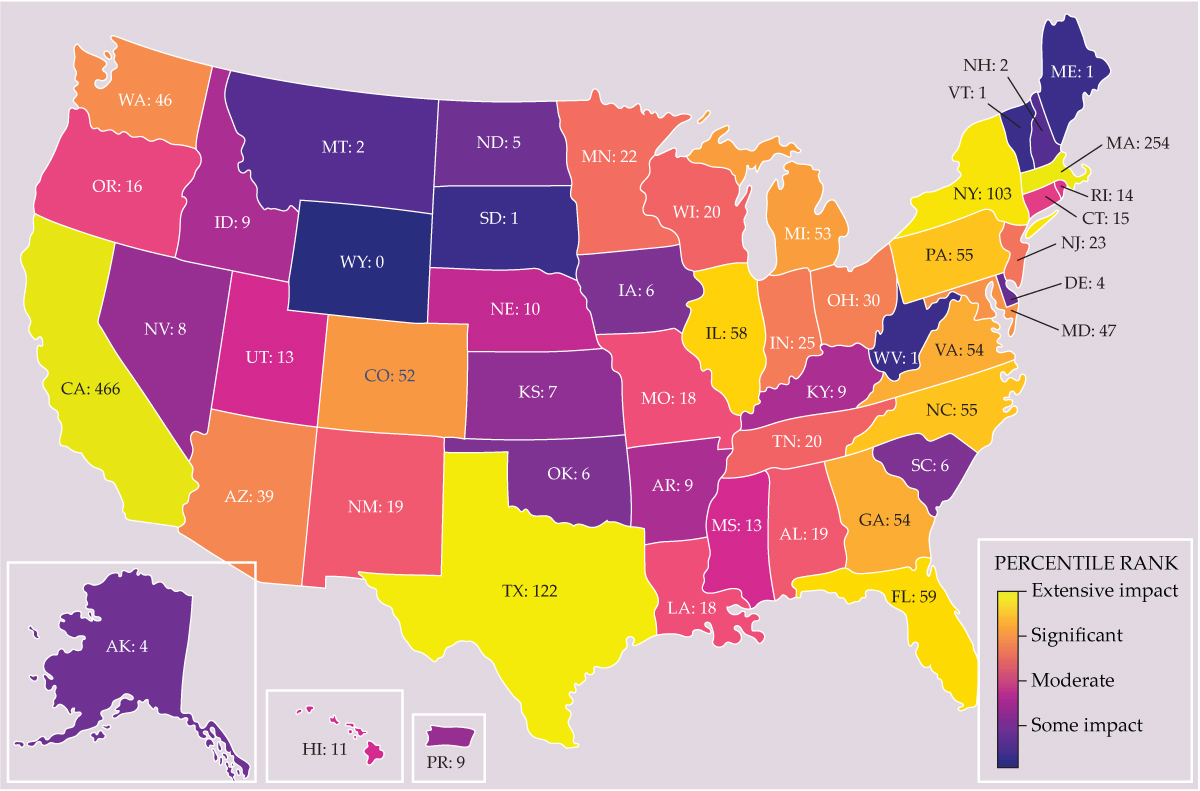
A map of NSF grant impacts by state, created from Grant Witness data, reveals the hot spots nationwide as of 29 August. The numbers and colors indicate the total number of grants impacted, including canceled and possibly reinstated grants. (Image courtesy of Grant Witness).In the spring, NSF began canceling some previously awarded grants. The cuts targeted research in diversity, equity, and inclusion initiatives; environmental justice; and misinformation. Separately, the Trump administration froze federal funding at several large US research universities. Court challenges and settlements have since reinstated some grants, which has led to an evolving patchwork of federal science cuts. The cancellations and reinstatements can now be seen in one place with the online tracker Grant Witness.Noam Ross, a computational researcher and executive director at the nonprofit rOpenSci, and Scott Delaney, a Harvard University social and environmental epidemiologist, launched the tracker in March to track National Institutes of Health grant cancellations. NIH had posted conflicting information about the extent of the cuts, says Ross, so he and Delaney started collecting a list of grants through submissions from affected principal investigators, court filings, and official lists when available. The two researchers vetted submissions by comparing them with publicly available federal award identification numbers and the government’s spending database tool, USAspending.gov. The tracker was originally called Grant Watch, but the pair renamed it Grant Witness in July for trademark reasons.Grant Witness began tracking NSF grants in April when the agency announced the first round of cuts. A small group of organizers helps Ross and Delaney regularly update the lists to reflect new cancellations or reinstatements. Ross has spent about $100 out of pocket to host the website, and the group received a small grant from the Alfred P. Sloan Foundation to fund one person for a few hours a week. All other organizers volunteer their time. Ross says the group is seeking more funding to support the work.The cuts hit home for the Grant Witness team in May: Delaney’s grants were terminated when the administration canceled all NIH funding to Harvard. Delaney says he expects to lose his job at Harvard as a result.
Two Valuable Satellites Are in ‘Perfect Health.’ They May Be Scrapped.. The Trump administration wants to switch off and possibly destroy the climate-monitoring technology. Starting back in the Bush administration, the United States has spent more than $800 million launching powerful climate-monitoring satellite technology into space. The satellites, known as the Orbiting Carbon Observatory missions, came with huge risks. In 2009 the first launch attempt failed, incinerating a satellite. But two later missions were successful, and today the satellites are in “perfect health,” according to a government report issued in January.Now, however, the Trump administration wants to scrap them as a money-saving measure.It’s like buying a car “and then running it into a tree after a few years, just to save the price of tank of gas,” said David Crisp, a former scientist at the NASA Jet Propulsion Laboratory who led the missions to launch the satellites, which help monitor plant life and greenhouse gases and are used by forecasters, farmers and scientists.He noted that most of the expense of the satellites was at the front end. “They cost a vast amount to build,” he said. But, once in orbit, “they cost a fraction of that a year to operate.” The satellites have more than a decade of life left in them, Dr. Crisp said.In May, the Trump administration proposed to cut NASA’s 2026 budget by 25 percent and to cut spending for Earth and climate science in half. Bethany Stevens, the NASA spokeswoman, said the president’s 2026 budget aimed to realign the agency with the “core mission of space exploration.”At other science agencies, including the National Oceanic and Atmospheric Administration and the National Science Foundation, the administration has also asked Congress to shrink spending for next year. A smaller budget request “provides ample resources to advance our mission while cutting through bureaucratic bloat and agenda-driven programs that dilute NOAA’s impact,” said Kim Doster, the agency’s spokeswoman.Congress has resisted the Trump administration’s proposed cuts. Budget bills currently under consideration in both chambers would restore funding at all three agencies to near-current levels. Still, weeks remain before a final funding package is approved and the numbers could change.Some agencies are already preparing to follow the president’s version of the budget, such as making plans to turn off satellites, according to two senior officials at federal science agencies who requested anonymity out of concern over retribution.Kennedy Renews Attacks on C.D.C. at Contentious Senate Hearing Robert F. Kennedy Jr. defended his tenure as health secretary as the panel’s top Democrat accused him of lying about vaccines and endangering public health.
Harvard University won a crucial legal victory in its clash with the Trump administration on Wednesday, “when a federal judge said that the government had broken the law by freezing billions of dollars in research funds in the name of stamping out antisemitism. The New York Times, September 3, 2025. The ruling may not be the final word on the matter, but the decision by Judge Allison D. Burroughs of the U.S. District Court in Boston was an interim rebuff of the Trump administration’s campaign to remake elite higher education by force. Harvard’s case centered on its research funding, and the university contended that the administration had compromised its First Amendment and due process rights when it sought to strip it away. The judge’s decision could give Harvard new leverage in its settlement talks with the White House. Although the ruling was a milestone for Harvard, the only university to sue over the administration’s assault on its research funding, President Trump had vowed to appeal any decision that went against him. His administration has spent months seeking to pressure Harvard in ways beyond research money, and while Judge Burroughs’s ruling may not put an end to that campaign, her opinion was a bracing rebuke. “We must fight against antisemitism, but we equally need to protect our rights, including our right to free speech, and neither goal should nor needs to be sacrificed on the altar of the other,” Judge Burroughs wrote in an 84-page ruling. “Harvard is currently, even if belatedly, taking steps it needs to take to combat antisemitism and seems willing to do even more if need be.” She added, “Now it is the job of the courts to similarly step up, to act to safeguard academic freedom and freedom of speech as required by the Constitution, and to ensure that important research is not improperly subjected to arbitrary and procedurally infirm grant terminations, even if doing so risks the wrath of a government committed to its agenda no matter the cost.” As a part of the decision, Judge Burroughs said the Trump administration could not issue new blockades on Harvard’s federal research funding “in retaliation for the exercise of its First Amendment rights, or on any purported grounds of discrimination without compliance with the terms” of civil rights law. Harvard did not immediately respond to a request for comment. The White House, however, condemned the ruling. “To any fair-minded observer, it is clear that Harvard University failed to protect their students from harassment and allowed discrimination to plague their campus for years,” said Liz Huston, a White House spokeswoman. “Harvard does not have a constitutional right to taxpayer dollars and remains ineligible for grants in the future. She added that the government would “appeal this egregious decision, and we are confident we will ultimately prevail in our efforts to hold Harvard accountable.” Judge Burroughs’s decision came on the second day of classes for the new academic year and after both the government and the university asked her to issue what is known as summary judgment — a ruling on the case’s claims without a trial. She largely ruled for Harvard, relying on voluminous filings, a select batch of evidence and oral arguments in her Boston courtroom on July 21 to reach a decision. Harvard brought the case in April, after the Trump administration insisted that the nation’s oldest university had became a wellspring of bigotry. On April 11, it sent the school a letter trying to condition Harvard’s access to federal research money on its acquiescence to a range of demands. Those terms included audits, the establishment of “merit-based” admissions and hiring policies, the shutdown of diversity, equity and inclusion programs and an examination of “programs and departments that most fuel antisemitic harassment or reflect ideological capture.” Harvard refused on April 14. The administration took only hours to announce it would begin cutting off funding that Harvard, like other prominent universities, had long relied on to pay for research. The university sued a week later, accusing the government of ignoring its First Amendment protections and hastily barreling past the thicket of laws and regulations that govern how federal funding can be revoked…”
Snubbing Kennedy, States Announce Plans to Coordinate on Vaccines, The New York Times, September 3, 2025. California, Oregon and Washington announced plans on Wednesday to form a “health alliance” that would coordinate vaccine recommendations for the three states. The alliance is intended to provide residents with scientific data about vaccine safety and efficacy, and to issue guidance on vaccines for respiratory illnesses like Covid and the flu, as well as an array of childhood immunizations. The move comes at a time of unparalleled turmoil at the Centers for Disease Control and Prevention, the federal agency responsible for issuing vaccine guidance for the whole country. In a joint statement, governors of the three states said that the C.D.C. had become “a political tool that increasingly peddles ideology instead of science, ideology that will lead to severe health consequences.” The agency has lost thousands of employees since January, most recently its director. The governors said the new alliance would protect against what they called the “politicization of science” by helping families, medical providers and vaccine manufacturers plan for the future using “consistent, science-based recommendations they can rely on — regardless of shifting federal actions.” The announcement did not address an array of brewing questions. Among them: whether health insurance plans would cover the cost of vaccines that were recommended by states but not by the federal government; whether primary care doctors and pharmacies could face repercussions for providing them; and whether states may continue to require certain vaccinations if they are no longer recommended by the C.D.C. Western states formed a similar working group during the peak of the Covid pandemic to boost public confidence in vaccines. States in the Northeast have recently gathered to discuss coordinating their own vaccine recommendations. In June, the governors of California, Oregon and Washington jointly condemned Health Secretary Robert F. Kennedy Jr.’s decision to dismiss all 17 vaccine experts on the federal Advisory Committee on Immunization Practices. The secretary went on to appoint vaccine skeptics to several of the posts and to end $500 million in federal funding for mRNA vaccines, a category that includes several of the most widely used and effective Covid shots. Federal vaccine policies have been changing rapidly since Mr. Kennedy was appointed. Last week, the Food and Drug Administration limited its approval of updated versions of Covid shots to people who are 65 or older or who have a medical condition that puts them at higher risk of severe illness. No one else would be eligible for the new shots under the F.D.A. approval, even if they lived with someone at high risk.
America First? Not When It Comes to Your Health.
A group of more than 85 scientists have issued a joint rebuttal to a recent U.S. Department of Energy report about climate change, finding it full of errors and misrepresenting climate science. NPR: The group of climate scientists found several examples where the DOE authors cherry-picked or misrepresented climate science in the agency’s report. For instance, in the DOE report the authors claim that rising carbon dioxide can be a “net benefit” to U.S. agriculture, neglecting to mention the negative impacts of more heat and climate-change fueled extreme weather events on crops.
The DOE report also states that there is no evidence of more intense “meteorological” drought in the U.S. or globally, referring to droughts that involve low rainfall. But the dozens of climate scientists point out that this is misleading, because higher temperatures and more evaporation — not just low rainfall — can lead to and exacerbate droughts. They say that there are, in fact, many studies showing how climate change has exacerbated droughts.
Over 85 scientists say Trump Energy Dept. climate report lacks merit. NBC News. They say it “fails to adequately represent the current scientific understanding of climate change.”
D.C. Circuit panel rules 2-1 to permit Trump administration to axe $16 billion climate funds authorized by Biden administration. Ruling lifts Judge Chuktkan’s injunction. https://s3.documentcloud.org/documents